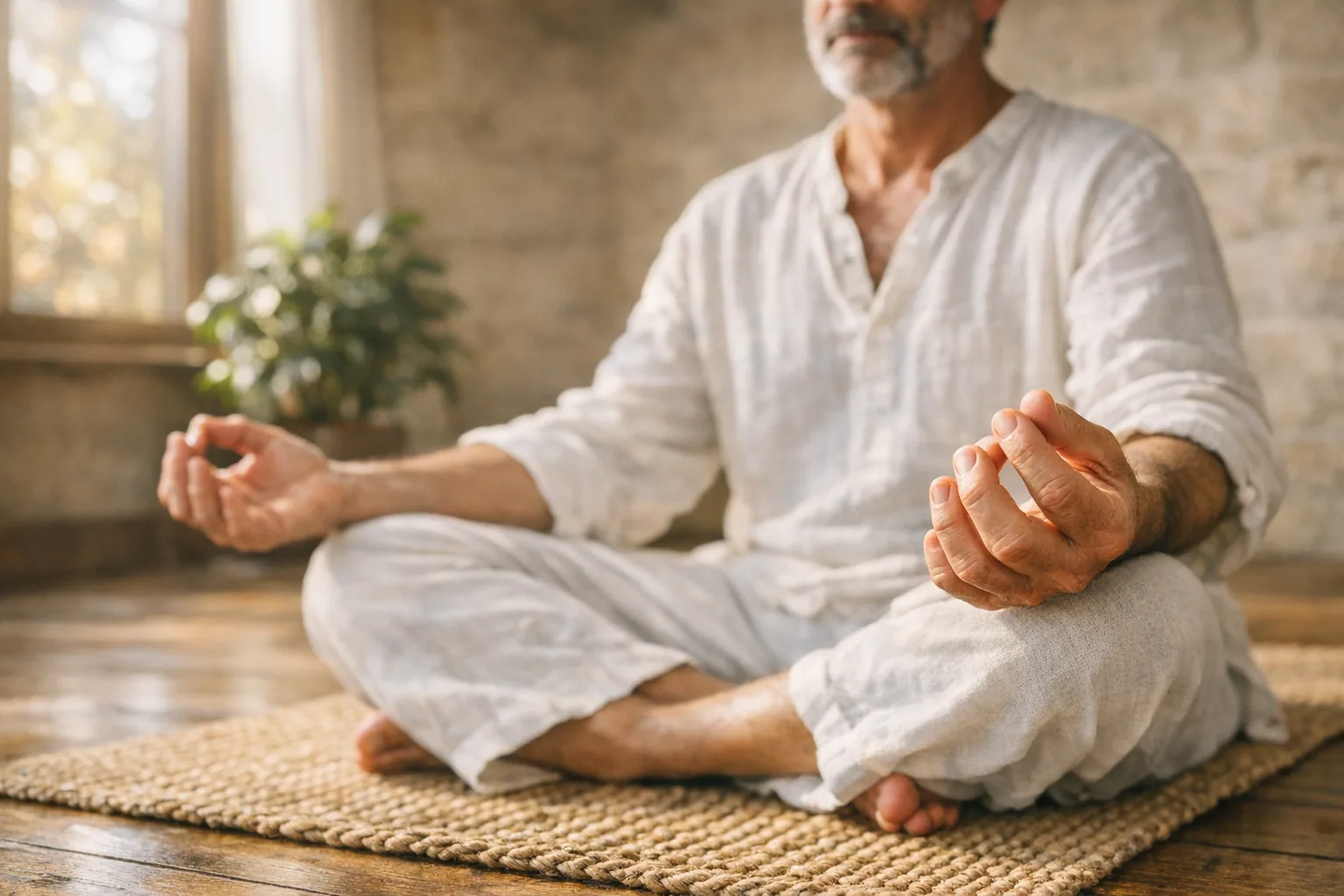
Zazen: Posture, Breathing and Silence
Retiru Team
The Retiru content team — yoga, meditation and ayurveda.
Introduction
Zazen is often translated as seated meditation, but the phrase does not fully capture the practice. In practical terms, it means sitting in a stable posture, breathing naturally through the nose and remaining in silence without trying to produce a special state. The aim is not to empty the mind or to have an extraordinary experience. It is to train a sober kind of presence: noticing what appears, returning to the body and allowing the breath to become a steady reference point.
Its simplicity is also what makes it demanding. There are no complex visualisations, background music or continuous instructions to keep attention entertained. Zazen places you in front of the basics: the seated body, the breath coming and going, and the natural movement of the mind. For this reason, it is best approached with patience, an adapted posture and realistic expectations.
This guide explains how to begin safely and clearly: how to sit, where to place the hands, what to do with the eyes, how to breathe, how long to practise and which mistakes to avoid. It also includes precautions, because silent meditation is not equally suitable for everyone at every moment.
What zazen is and how it differs
Zazen belongs to the Zen Buddhist tradition and is practised sitting, in silence, with direct attention to posture and breathing. It is sometimes described as just sitting, but this sitting is not passive. The spine is upright, the pelvis supports the trunk, the hands rest in a stable mudra and the gaze is usually soft, with the eyes half open.
Unlike many guided meditations, zazen uses very few external supports. It does not rely on imagery, affirmations or music, although it may have a calming effect. Nor is it a rigid concentration exercise in which everything else must be excluded. The basic instruction is to remain present: recognise thoughts, sensations and emotions without following them, then return again and again to the seated body and the breath.
Some approaches use breath counting, while others emphasise a more open practice known as shikantaza, often translated as just sitting. For beginners, counting the exhalations from 1 to 10 can be helpful during the first weeks. It gives the mind a simple anchor. Over time, this support can become lighter, leaving a broader and less effortful awareness.
Silence is central. In zazen, silence is not decoration or escape. It allows you to notice more clearly what is already happening: tension in the jaw, impatience, sleepiness, the urge to move, shallow breathing or repetitive thoughts. Silence does not remove experience; it reveals it.
Benefits and realistic limits
Regular zazen can support sustained attention. Sitting for 10, 15 or 20 minutes without jumping from one stimulus to another trains the ability to stay with one activity. This may help with work, study, listening and everyday tasks that require steadiness rather than constant stimulation.
It can also improve your relationship with stress. By observing breath and body sensations, many people begin to detect early signs of activation: raised shoulders, a tight abdomen, short breathing or the impulse to react. The benefit is not that stress disappears. It is that a small space opens between stimulus and response, and that space can reduce impulsive reactions to fear, anger or fatigue.
Physically, the posture may improve awareness of the spine, pelvis and natural breathing. Zazen does not require exaggerated deep breathing. In fact, breathing is usually silent, nasal and unforced. When you stop interfering so much, the breath often becomes steadier by itself.
However, zazen should not be oversold. It does not replace psychotherapy, medical care or adequate sleep. It does not guarantee immediate calm. At first, it may even make discomfort, anxiety or mental agitation more visible, simply because you stop covering them with activity. This is not failure; it is part of seeing clearly.
The most important limit is this: zazen is not a fight against thoughts. Thinking during meditation does not mean you are doing it wrong. The mind produces plans, memories, images and judgements. The practice is to notice and return. That repeated return is the training.
Step-by-step protocol
1. Prepare the space: 2 minutes
Choose a clean, ventilated and relatively quiet place. It does not need to be perfect; it only needs to allow a few minutes without predictable interruptions. Turn off notifications and set a timer with a gentle sound. You may sit facing a wall or a neutral point in the room. A distance of about 1 to 2 metres from the wall is usually enough.
2. Choose a stable posture: 3 minutes
The classic posture uses a zafu, or meditation cushion. Sit in the centre or slightly toward the front edge. The height of the cushion helps the knees descend and the pelvis tilt gently forward, allowing the spine to rise without forcing the back.
There are several valid options. Full lotus requires considerable hip mobility and is not necessary for beginners. Half lotus may work if there is no knee or ankle pain. The Burmese posture, with both legs crossed and both feet resting in front, is often more accessible. You can also sit in seiza on a meditation bench or cushion, or on a chair with both feet flat on the floor.
The point is not to imitate a perfect image. Look for three things: a stable pelvis, supported knees or feet, and a spine that can stay upright. If your knees float in the air, support them with folded blankets. If you feel sharp joint pain, change posture.
3. Align spine, head and gaze: 1 minute
From the pelvis, let the spine lengthen upward. The chest does not need to be pushed forward; the shoulders can drop naturally. Slightly tuck the chin, as if the back of the neck were lengthening. The crown of the head rises without stiffness.
Keep the eyes half open if possible, with the gaze resting downward at about a 45-degree angle. This avoids two common extremes: closing the eyes and becoming sleepy, or staring with tension. If you need to close your eyes at first, do so, but keep the body alert.
4. Place the hands: 1 minute
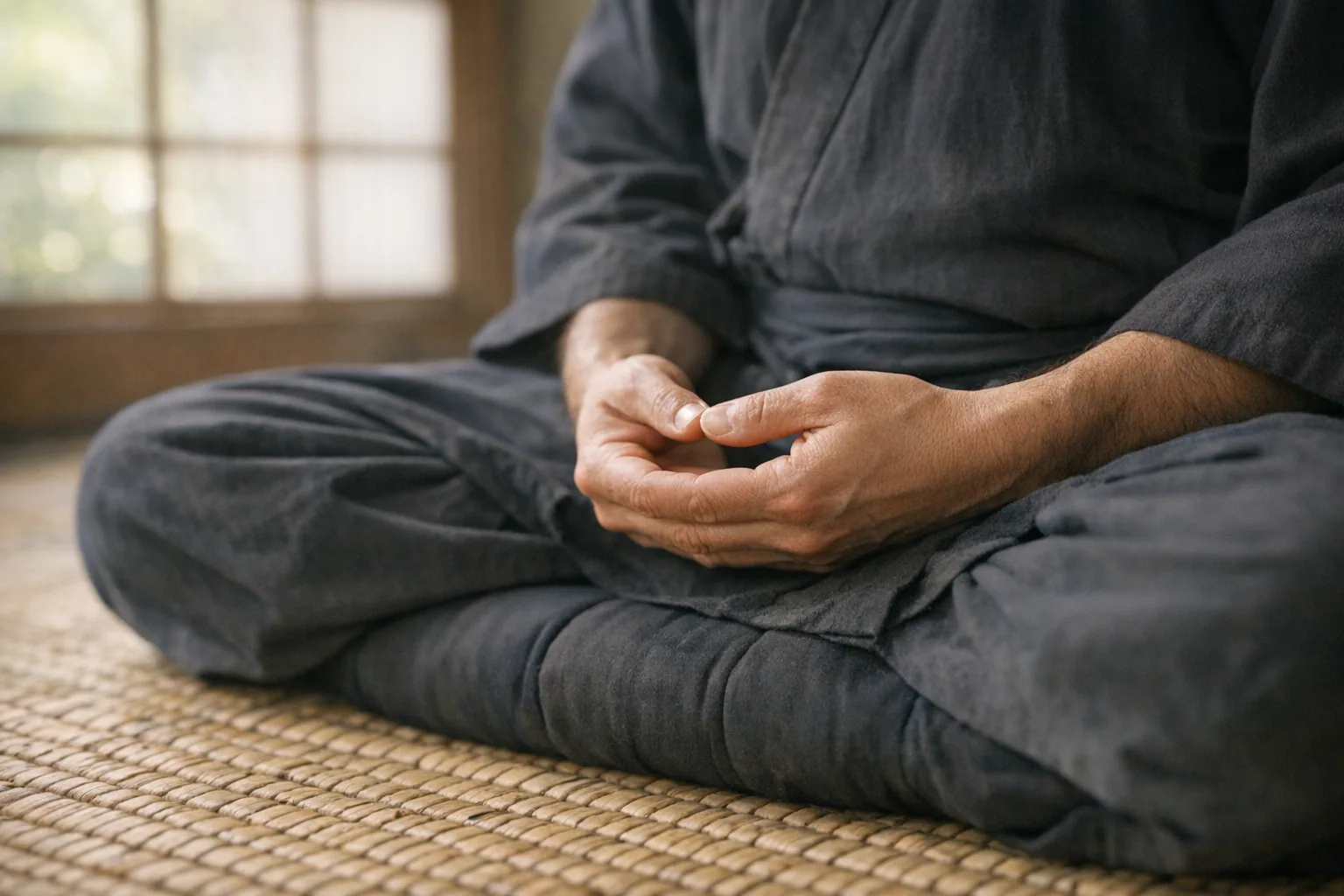
Zazen often uses the cosmic mudra, or hokkaijoin. Place the left hand over the right, palms facing upward, and let the thumbs touch lightly, forming an oval. The hands rest near the lower abdomen, supported by the thighs or by a small cushion if the shoulders tense.
The thumbs can reveal your state of attention. If they press hard, you may be forcing. If they collapse and separate, sleepiness may be present. Do not obsess over this; simply use it as a gentle signal to adjust.
5. Breathe naturally through the nose: 5 to 20 minutes
During zazen, breathe silently through the nose whenever possible. Do not try to create impressive breathing. Allow the air to enter and leave naturally. At the beginning, the breath may be short or irregular. Notice it without immediately correcting it.
For beginners, count the exhalations. Inhale naturally, exhale and count one. On the next exhalation, count two, continuing up to ten, then return to one. If you get lost in thought and realise you have forgotten the count, return to one without inner criticism.
Start with 5-minute sessions for one week if you are new to meditation. Then move to 10 minutes. Once the posture feels stable, try 15 or 20 minutes. A session is not better just because it is longer. Ten minutes daily is more useful than forty minutes once a month.
6. Close the session: 2 minutes
When the timer rings, do not stand up abruptly. Feel the whole body, move fingers and toes, and release the legs carefully. If you were sitting on the floor, lean forward slightly before standing. You can walk slowly for 1 or 2 minutes, bringing attention to the soles of the feet.
In Zen contexts, walking meditation, or kinhin, is often practised between sitting periods. At home, take very small steps, coordinating each step with a breath or half breath while keeping the body upright. This helps integrate stillness into movement.
Common mistakes
A frequent mistake is confusing stability with rigidity. An upright back is not a military back. If you clench the jaw, lock the abdomen or raise the shoulders, the posture is too hard. Zazen posture has tone, but it must also allow breathing.
Another mistake is trying to control the breath. Many people think good meditation means slow, deep and perfect breathing. In zazen, breathing is observed and allowed. It may become longer and quieter, but not through force. Forcing the exhalation or inflating the abdomen artificially can create tension or dizziness.
A third mistake is judging the session by the number of thoughts. A session full of thoughts is not necessarily bad; it may simply show you the speed of the mind. The issue is not that thoughts appear, but that you follow them without noticing. Even then, the moment of noticing is already practice.
It is also common to tolerate unnecessary pain. Mild discomfort can be part of sitting still, but sharp pain, strong tingling or joint pressure should not be ignored. Use a chair, raise the cushion or support the knees. Discipline is not the same as injury.
Who it suits and contraindications
Zazen may suit people looking for a quiet, simple and disciplined practice with little dependence on external stimulation. It is useful for training attention, patience and the ability to observe reactions before acting on them. It can also be a good next step for people who have used guided meditations and want a more autonomous practice.
It may be less suitable, especially without support, for people going through intense anxiety, severe depression, recent trauma, frequent dissociation or psychotic symptoms. Prolonged silence can amplify difficult internal material when regulation skills are limited. In these cases, it is better to consult a mental health professional and begin with shorter, guided, body-based practices.
Physically, adapt the posture if you have knee, hip, ankle or back injuries. Sitting on a chair is completely valid: feet flat, pelvis slightly elevated if needed, spine upright and hands resting in the lap. If pain persists after practice, review the posture before increasing duration.
Avoid practising as self-punishment. If you are exhausted, feverish, under the effects of alcohol or severely sleep-deprived, a long zazen session may not help. Rest, a gentle walk or a short breathing practice may be wiser.
Suggested weekly routine
Think in weeks, not heroic resolutions. Consistency grows through small, repeatable sessions.
Week 1: practise 5 minutes a day, 5 days a week. The goal is simply to sit down and learn the posture.
Week 2: increase to 8 or 10 minutes, 5 days a week. Count exhalations from 1 to 10. If you are very agitated, keep it to 5 minutes and finish with 2 minutes of slow walking.
Week 3: practise 10 minutes daily or 15 minutes every other day. Notice which posture gives stability without pain. Adjust the cushion, try a chair or support the knees if needed.
Week 4: introduce one 20-minute session per week, keeping 10-minute sessions on the other days. If sleepiness appears, keep the eyes half open and avoid practising too late. If there is too much tension, soften the jaw, abdomen and hands.
After the first month, a realistic base is 10 to 20 minutes, 4 to 6 days per week. For longer practice, divide it into blocks: 20 minutes sitting, 5 minutes slow walking and another 15 or 20 minutes sitting.
FAQ
Is it better to practise with eyes open or closed?
Traditionally, eyes are half open, with a soft downward gaze. This supports wakefulness and reduces daydreaming or sleepiness. If closing the eyes helps at first, you can do it, but notice whether it makes you dull. Over time, experiment with half-open eyes.
Do I need full lotus to practise zazen properly?
No. Full lotus is traditional but not required. Burmese posture, half lotus, seiza with a bench or sitting on a chair can all support serious practice. What matters is a stable pelvis, an upright spine and the ability to breathe without pain.
What should I do if I feel very bored?
Boredom is common in zazen. Instead of treating it as a problem, observe it physically. Where do you feel it? What thoughts come with it? Is there an urge to stop? You do not need to make the session interesting. Return to the body, the exhalation and the contact with the ground.
How long does it take to notice changes?
It varies. Some people feel calmer quickly; others meet restlessness for several weeks. A reasonable period is 10 minutes, 5 days a week, for 4 weeks. Look for concrete signs: you react less quickly, notice tension earlier or tolerate silence more easily.
Closing
Zazen is direct: stable posture, natural breathing and silence. It does not need decoration, but it does require care. Sitting well is not about achieving a perfect shape; it is about finding a base from which the body can stay awake and the mind can be seen honestly. Breathing well is not control, but allowing. Silence is not emptiness, but the space to notice.
If you are beginning, keep it simple: 5 or 10 minutes, an adapted posture and a firm but kind attention. Some sessions will feel clear, others confused. Both are part of the training. The depth of zazen comes not from forcing an experience, but from returning again and again to what is already here: the seated body, the breath coming and going, and enough silence to notice.
Ready for your next retreat?
Explore hundreds of retreats across Spain with transparent pricing.
Explore retreats