Vipassana: observing sensations without judging
Retiru Team
The Retiru content team — yoga, meditation and ayurveda.
Introduction
Vipassana is often translated as clear seeing or insight. In practical terms, it is not about emptying the mind or chasing a special state. It is the training of observing what happens in the body and mind with less automatic reaction. A sensation appears, you notice it, and you practise not turning it immediately into liking, disliking, judgement or personal story.
The practice is based on a very concrete observation: mind and body are deeply connected. Worry may show up as pressure in the chest, heat in the face or tension in the jaw. A pleasant mood may feel like lightness, warmth or expansion. Vipassana asks you to observe these bodily sensations with equanimity, neither clinging to pleasant ones nor fighting unpleasant ones.
For beginners, the practice can start with 10 to 15 minutes. A long silent retreat is not necessary to understand the basic method, although traditional retreats do exist and can be demanding. The essential point is to build an honest relationship with direct experience: breath, contact with the chair or floor, temperature, pressure, pulsing, tingling, mild discomfort, thoughts and emotions as they arise and pass.
What this practice is and how it differs
Vipassana is a practice of self-observation. In many approaches, attention is first stabilised through the breath and then expanded to bodily sensations. A common method is the body scan: moving attention through the body, area by area, and noticing what is present without trying to change it. There may be obvious sensations, such as tight shoulders, or subtle ones, such as warmth, vibration, pulsing or an apparent absence of sensation.
It differs from purely concentration-based meditation because it is not limited to holding attention on one object. Concentration supports the practice, but the deeper aim is to see the changing nature of experience. A sensation appears, stays for a while, shifts or disappears. A thought arrives, takes space and fades if it is not fed. The practice is to see this process repeatedly, not to force calm.
It also differs from guided relaxation. Vipassana may bring calm, but it is not only a relaxation technique. If discomfort, boredom or restlessness appear, they are also included in the observation. This matters because if meditation is used only to feel good, difficult sessions will be seen as failures. In Vipassana, a difficult session can be valuable if it reveals how you react to discomfort.
Nor is it psychological analysis. If sadness appears, the instruction is not to spend the session asking why you are sad. Instead, you notice how sadness is experienced: heaviness, tightness, moisture in the eyes, shallow breathing, a desire to withdraw. Analysis may be useful after practice, but during practice the priority is direct observation.
Benefits and realistic limits
One of the clearest benefits of Vipassana is learning to create a pause between stimulus and reaction. By observing sensations without responding immediately, you learn that not every discomfort requires automatic behaviour. An itch does not always need scratching, a tension does not always require changing posture instantly, and an emotion does not always require speaking, eating, scrolling or arguing. This pause can gradually transfer into daily life.
Vipassana can also improve body awareness. Many people miss basic signals such as fatigue, shallow breathing, accumulated tension or real hunger. By scanning the body with care, these signals become easier to recognise. This is not about becoming obsessed with every sensation, but about noticing patterns: where stress accumulates, which areas contract during worry, and how the body changes before an emotional reaction.
Emotionally, the practice helps show that emotions have changing physical components. Anxiety, for example, is not only a concept. It may be tightness, heat, acceleration, emptiness in the stomach or restless legs. When these sensations are observed with less judgement, they may lose some of their intensity. They do not always disappear, but they become less vague and overwhelming.
The limits should be clear. Vipassana is not a replacement for psychotherapy, medical treatment or social support. It does not by itself cure depression, trauma, chronic pain or anxiety disorders. It can be a useful complementary tool, depending on the person, the context and the way it is practised. If observation becomes a way to avoid action when action is needed, such as asking for help or setting boundaries, the practice has been misunderstood.
Step-by-step protocol
Preparation: 2 minutes
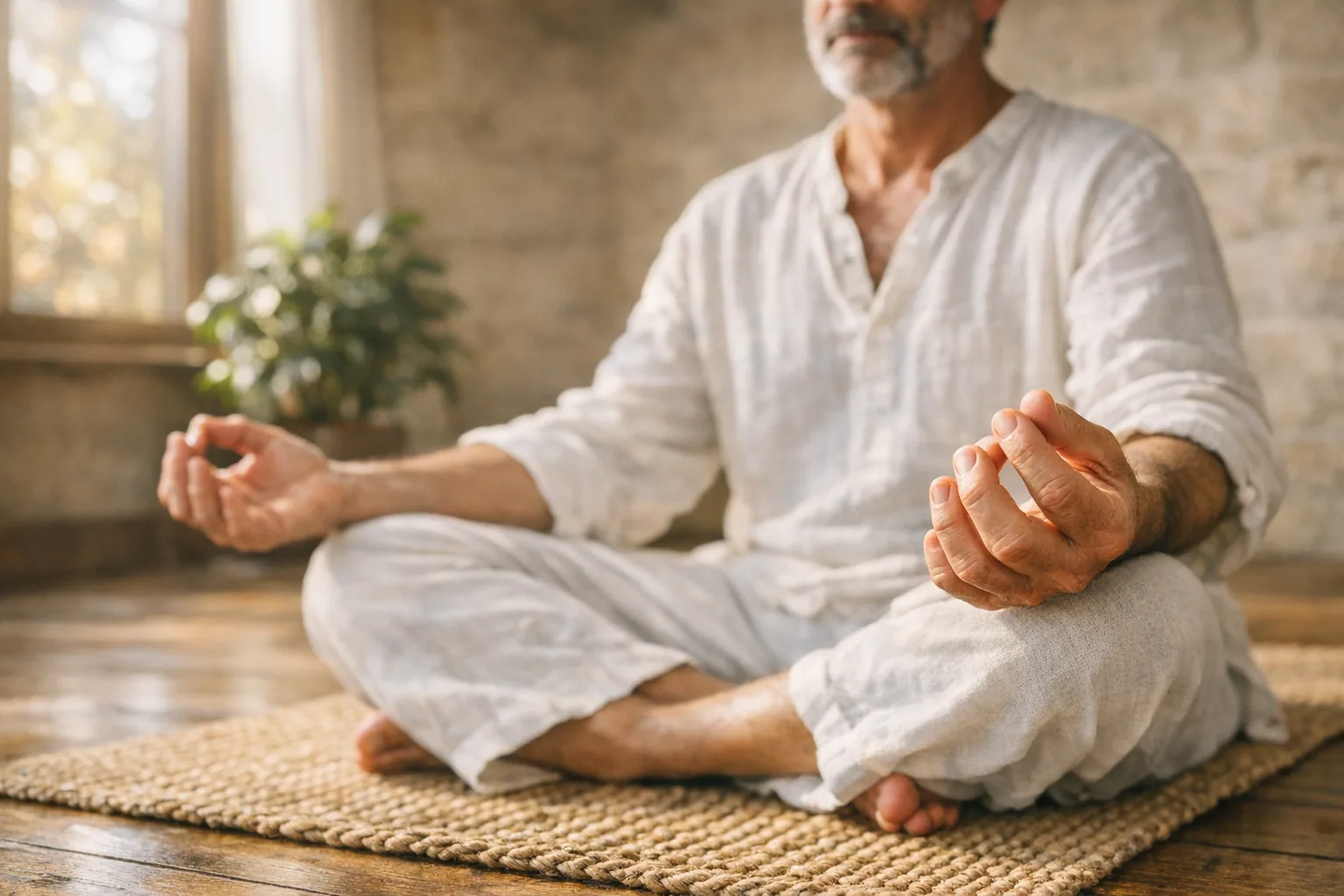
Choose a simple, reasonably quiet place. Sit on a chair with both feet on the floor, on a cushion, or on a meditation bench. Keep the spine upright but not stiff. Place the hands on the thighs or in the lap. You may close the eyes gently, or keep them slightly open with a soft downward gaze if closed eyes feel uncomfortable.
Decide the duration before starting. Beginners can begin with 10 minutes. If you have experience, 20 to 40 minutes may be suitable. A timer helps prevent checking the clock. Set a simple intention: for this period, I will observe what appears without trying to turn it into something else.
Breath as an anchor: 3 to 5 minutes
Bring attention to the natural breath. There is no need to breathe deeper or slower. Notice where the breath is clearest: nostrils, chest, ribs, abdomen or the whole body moving. Each time the mind wanders, recognise it gently and return to one concrete breath.
This phase is not meant to eliminate thoughts. Noticing distraction is already part of the training. You may label it briefly: thinking, planning, remembering, hearing. Then return to the felt breath. If self-judgement appears, observe that too as another mental event.
Body scan: 8 to 20 minutes
Begin at the top of the head and move slowly downward: forehead, eyes, jaw, neck, shoulders, arms, hands, chest, abdomen, back, pelvis, thighs, knees, legs and feet. Stay with each area for a few seconds, long enough to notice pressure, temperature, vibration, tingling, tension, pulsing, lightness or lack of clear sensation.
The key instruction is not to react. If a pleasant sensation appears, do not try to prolong it. If an unpleasant sensation appears, do not reject it immediately. Notice whether it changes in intensity, shape or location. You can ask quietly: what is here now? This is not an intellectual question, but a way to refine perception.
If an area feels neutral or blank, do not force it. Stay for a few seconds and move on. Lack of sensation is also part of the experience. With regular practice, many areas become more perceptible, but chasing subtlety usually creates tension. A mature practice can stay with what is obvious without demanding something special.
Open awareness: 2 to 5 minutes
After the scan, widen attention to the whole seated body. Include breath, contact, temperature, sounds, thoughts and emotional tone. If something becomes very prominent, such as back discomfort or a strong feeling, observe it briefly and return to the wider field.
This stage helps integrate the practice. The aim is not to get trapped in each detail, but to recognise the flow of experience. Sensations increase and decrease, thoughts arise, sounds disappear. Seeing this changing quality is central to Vipassana.
Closing: 1 minute
Before opening the eyes, feel the breath and the contact of the body again. Notice how you are without judging the session as good or bad. Move fingers, neck and shoulders gently. Stand up slowly if needed. A careful closing prevents meditation from feeling separate from the rest of the day.
Common mistakes
A frequent mistake is confusing non-judgement with feeling nothing. Vipassana does not aim at emotional numbness. It allows you to feel more precisely, while adding less mental resistance. You may notice pain, sadness or irritation and still observe how they express themselves in the body.
Another mistake is turning the technique into an endurance test. Posture matters, but clear signs of harm should not be ignored. Mild discomfort can be observed; sharp pain, nerve compression or dizziness require adjustment. Equanimity is not physical punishment.
It is also common to chase subtle sensations. Some people read about vibrations or energetic currents and begin looking for a particular experience. This interferes with observation. If there is tingling, observe tingling. If there is heaviness, observe heaviness. If there is boredom, observe boredom. The practice is not better because sensations are dramatic.
A fourth mistake is over-analysing. During meditation, the mind may explain everything: this comes from childhood, this means I am progressing, this proves I am doing it wrong. In Vipassana, those are thoughts. They are recognised, and attention returns to the body.
Who it suits and contraindications
Vipassana may suit people who want to develop body awareness, reduce reactivity or understand mental patterns more clearly. It can be especially useful for those who act impulsively when discomfort, stress or strong emotion appears. It may also suit people already familiar with mindfulness who want to deepen their observation of bodily sensations.
It is not always the best starting point. If someone is experiencing an acute psychological crisis, suicidal thoughts, psychosis, intense dissociation, recent trauma or frequent panic attacks, it is wise to consult a mental health professional before practising deeply. Silent observation can amplify difficult emotional material if there is not enough support. In such cases, brief practices with open eyes, orientation to the room, gentle movement or therapist-guided exercises may be safer.
Long silent retreats also require caution. Practising many hours a day for several days is demanding, not simply a longer relaxation session. It may be valuable for some people, but it should not be assumed necessary or harmless for everyone. If there is a history of severe depression, trauma, eating disorders, substance misuse or emotional instability, timing and support matter.
Physically, people with chronic pain, back injuries, circulatory issues or joint limitations should adapt posture. Sitting on a chair is completely valid. Lying down can also work, although it often increases sleepiness. The priority is a stable posture that supports observation without unnecessary suffering.
Suggested weekly routine
In the beginning, consistency matters more than length. For the first month, try 10 to 15 minutes, 4 days per week. The first sessions can focus mainly on breathing and body contact; later sessions can include a simple body scan. The aim is not extraordinary depth, but becoming familiar with returning to direct experience.
From weeks 5 to 8, you can move to 20 minutes, 4 or 5 days per week. A useful structure is 5 minutes of breathing, 12 minutes of body scan and 3 minutes of open awareness. If you are particularly agitated one day, reduce the ambition and return to the breath. Regularity does not mean rigidity.
Once a week, add an informal 3-minute practice during the day. Pause, feel the feet, notice the breath and identify three bodily sensations without calling them good or bad. This connects meditation with daily life. Vipassana is not limited to the cushion; it can be practised when receiving criticism, waiting, feeling rushed or noticing fatigue.
FAQ
Do I have to empty my mind?
No. The mind will produce thoughts, memories, images and plans. The practice is to notice that this is happening and return to present sensations. Every recognised distraction is part of the training, not a failure.
What if a strong emotion appears?
First, return to something stable: feet on the floor, contact with the chair or breath in the abdomen. Then observe the emotion through bodily sensations for a few seconds. If it becomes overwhelming, open the eyes, look around, name objects in the room and stop the practice.
Is it normal not to feel some body areas?
Yes. Many areas feel unclear at first. Do not imagine sensations or force attention. Notice the lack of clarity, wait a few seconds and continue. Sensitivity often increases naturally with regular practice.
How long until I notice a change?
Some people feel calmer from the first sessions; others notice changes after several weeks. A reasonable test is 10 to 20 minutes, 4 days per week, for one month. Meaningful changes are often subtle: reacting a little less, recognising tension earlier or tolerating emotion better.
Closing
Vipassana is a sober and direct practice: observing breath, body and mind without adding unnecessary judgement. Its strength lies in patient repetition. Each time you notice a sensation and do not react automatically, you train a different relationship with experience.
This does not mean becoming indifferent. It means gaining clarity before acting. Practised with honesty and caution, Vipassana can become a practical way to meet discomfort, pleasure and uncertainty with more steadiness.
Ready for your next retreat?
Explore hundreds of retreats across Spain with transparent pricing.
Explore retreats