Shirodhara: What It Is, Session Length and Common Effects
Retiru Team
The Retiru content team — yoga, meditation and ayurveda.
Introduction
Shirodhara is one of the most recognizable Ayurvedic therapies: a person lying down, eyes covered, while a steady stream of warm oil flows gently over the forehead. From the outside it may look like a spa ritual, but in the Ayurvedic tradition it is considered a specific technique to calm mental activity, support relaxation and encourage deeper rest. Its appeal lies in the combination of simplicity and depth: there is no movement to perform, no effort to make, only a warm and repetitive stimulus that invites the nervous system to slow down.
It is important, however, to describe Shirodhara with care. It is not a miracle cure and it does not replace medical or psychological treatment for severe insomnia, clinical anxiety, disabling migraines or other health conditions. It can be a complementary relaxation therapy when performed by trained practitioners, with proper hygiene, suitable oil, controlled temperature and a short assessment beforehand. In many sessions it is combined with Ayurvedic massage, quiet breathing and a final period of rest.
This guide explains what Shirodhara is, how it is applied, how long it usually lasts and what effects people commonly report. It also covers precautions, basic choices according to constitution or season, and the difference between trying simplified practices at home and receiving a full treatment in a professional setting.
What Shirodhara is in the Ayurvedic tradition
The word Shirodhara is usually explained from two Sanskrit terms: shiro, meaning head, and dhara, meaning flow or stream. In practice, it refers to the continuous pouring of a warm liquid, usually oil, over the forehead, especially the area between the eyebrows. In Ayurveda this region is associated with the mind, the senses and nervous system balance. You do not need to adopt a mystical view to understand its practical effect: a warm, constant and predictable stimulus can encourage a deep relaxation response.
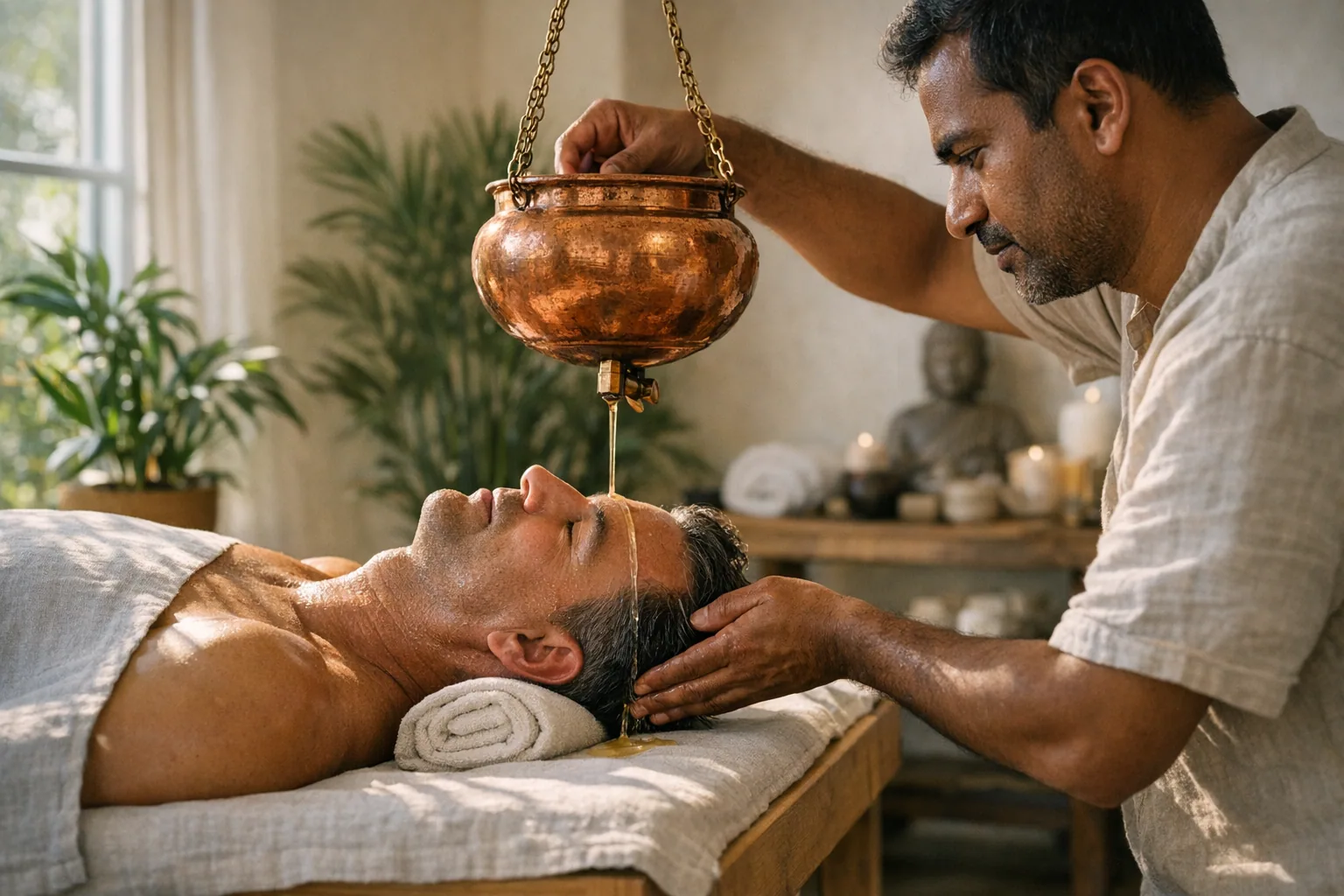
Unlike a conventional massage, Shirodhara is not mainly about manipulating muscles. Its central element is the steady flow of oil. The person lies on their back, usually covered with towels or sheets, with the head positioned under a vessel with an adjustable outlet. The oil falls onto the forehead in a continuous stream, sometimes with a gentle side-to-side movement, while the practitioner controls temperature, rhythm, direction and quantity.
Within Ayurveda, Shirodhara is often used when there is mental overactivity, poor sleep, accumulated stress, irritability or a feeling of depletion. Traditionally it is linked especially to balancing Vata dosha, which is associated with movement, dryness, irregularity and nervousness. Still, a careful session should not rely only on dosha labels. Age, health status, season, skin sensitivity, medication and the reason for seeking the treatment all matter.
It is also useful to distinguish traditional language from modern clinical evidence. Ayurvedic texts and practitioners attribute several benefits to Shirodhara, but not all of them have the same level of scientific support. A balanced approach is to speak of common effects, traditional uses and individual experience, without making absolute promises.
Uses and commonly attributed benefits
The best-known use of Shirodhara is deep relaxation. Many people describe a sense of mental quiet, light drowsiness or a state somewhere between waking and sleeping. This may be explained by several factors working together: warm temperature, repetitive contact on the forehead, reduced external stimulation, lying still and being in a quiet environment. Breathing often becomes slower and the body may feel pleasantly heavy.
In the Ayurvedic tradition it is used to support people dealing with stress, mental overload, mild insomnia or difficulty switching off at the end of the day. Some seek it when they feel head tension, eye fatigue, irritability or racing thoughts. It is also mentioned in relation to tension-type headaches, although anyone with diagnosed migraine, intense pain, new headaches or neurological symptoms should consult a healthcare professional first.
Another commonly attributed benefit is better sleep quality. Shirodhara should not be understood as a medical sedative, but as a relaxing intervention that may help the body transition toward sleep when stress and hyperarousal are part of the problem. It tends to work best when combined with consistent habits: regular sleep timing, less screen exposure at night, lighter evening meals, gentle breathing and a stable wind-down routine.
Depending on the oil used, Shirodhara may also feel nourishing for the scalp and hair. Warm oil can leave the scalp feeling softer, less dry and more comfortable. Traditional sources sometimes mention hair loss, greying or premature ageing, but these claims should be treated carefully. A more realistic statement is that Shirodhara can be part of a calming scalp-care experience, not a guaranteed cosmetic treatment.
How it is applied: oil, massage, duration and temperature
A professional session usually begins with a short intake. The practitioner asks about the reason for the visit, health conditions, pregnancy, medication, allergies, skin sensitivity and tolerance to heat. This step matters because Shirodhara involves prolonged contact with oil and continuous stimulation of a sensitive area. The person then lies face up on a treatment table, with the neck well supported and the body covered to prevent chilling.
Many protocols include a gentle massage beforehand, focused on the head, neck, shoulders or the whole body depending on the setting. This prepares the person to relax and helps release surface tension. The Shirodhara vessel is then positioned above the forehead and the flow is adjusted. The stream should be fine, continuous and stable, with no splashing, abrupt changes or uncomfortable pressure.
The oil is warm, never hot. In practice it should feel close to body temperature, and the practitioner should test it before application and monitor it throughout the session. Oil that becomes too cool may feel unpleasant; oil that is too warm can irritate the skin or create anxiety. Thermal comfort is not a minor detail, it is part of the treatment itself.
Session length varies according to school, purpose and individual constitution. As a practical reference, many Shirodhara sessions last around 45 minutes when preparation and the main application are included. In some settings, the continuous flow over the forehead may last between 20 and 40 minutes, while the full experience can extend to 60 or 75 minutes if it includes massage, cleaning of excess oil and final rest. For a first session, a moderate duration is usually wiser than a very long one.
At the end, excess oil is removed from the forehead and hair, and the person is given a few minutes to rest. This rest period is important. Getting up too quickly can cause light-headedness, especially after deep relaxation. It is better to sit up slowly, drink water in small sips and avoid demanding activity immediately afterward.
Choosing the oil according to dosha or season
In Ayurveda, the choice of oil is considered part of the treatment. It may be adapted to the person’s constitution, current imbalance and season. For Vata tendencies, traditionally linked to dryness, coldness, restlessness and irregular sleep, richer and warming oils such as sesame oil are often used, sometimes infused with herbs. The traditional intention is to bring warmth, steadiness and nourishment.
For Pitta tendencies, associated with heat, irritability, redness or inflammation, practitioners may choose softer and more cooling options. Coconut oil or specific medicated blends are sometimes used, always taking skin tolerance into account. If someone dislikes heat, has a sensitive scalp or is prone to dermatitis, both the oil and the temperature should be adjusted.
For Kapha tendencies, associated with heaviness, slowness, congestion or excess cold and dampness, a very long or heavy oil application may not be ideal. A shorter session or a lighter oil may be preferred, and the practitioner should avoid leaving the person feeling overly dull or sleepy. In cold seasons, warmth and room temperature matter; in summer, ventilation and avoiding overheating become more important.
Beyond doshas, practical criteria are essential. The oil should be good quality, clean, properly stored and suitable for the skin. Allergies to sesame, coconut, nuts, fragrances or medicinal plants must be discussed beforehand. Medicated oils can contain botanical extracts, and natural does not automatically mean harmless for everyone.
Precautions and when to seek advice
Shirodhara is generally gentle, but it is not appropriate for every person or every moment. It is best avoided during fever, acute infection, intense sinus congestion, open wounds on the scalp or forehead, active dermatitis, burns, known allergy to the oil used or extreme sensitivity to touch. It is also not advisable right after a heavy meal, after alcohol intake or when the body is too depleted to tolerate prolonged stimulation.
People with severe migraines, epilepsy, recurring vertigo, neurological disorders, very unstable blood pressure, intense anxiety, recent trauma or psychiatric conditions should seek medical or qualified professional advice first. The reason is not that Shirodhara is forceful, but that it can change body perception, induce drowsiness or bring up strong internal sensations. For some people, deep relaxation may feel uncomfortable if they do not feel safe.
During pregnancy, especially in the first trimester or in high-risk pregnancies, medical clearance is advisable, and the practitioner should have specific experience. Extra caution is also sensible when taking sedatives, anti-anxiety medication or any treatment that affects alertness and balance. After the session, avoid driving immediately if you feel sleepy, dizzy or slowed down.
A good practitioner should explain the process, ask about contraindications and make it easy to stop the session at any time. Warning signs during treatment include burning sensation, increasing headache, nausea, anxiety, intense cold, itching or difficulty breathing. If these occur, the flow should be stopped and the area cleaned calmly.
At home vs in a professional centre
A full Shirodhara treatment is best received in a professional setting, with a proper table, adjustable vessel, temperature control and supervision. The reason is not only technical. When someone is deeply relaxed, they should not have to worry about oil spills, timing, posture, stains or cleaning up. A trained practitioner can adjust the flow, observe reactions and shorten the session if needed.
At home, simplified alternatives are possible, but improvising a complete Shirodhara without experience is not recommended. Pouring oil over the forehead for many minutes can lead to eye irritation, chilling, slipping, stains or neck discomfort if the position is poor. Heating oil without control or using concentrated essential oils near the eyes and mucous membranes is also unsafe.
A safer home option is a gentle warm-oil scalp massage for 5 to 10 minutes, using a small amount of oil and keeping it away from the eyes. Another option is a warm compress on the forehead combined with slow breathing. These practices are not Shirodhara, but they share part of its purpose: reducing stimulation and creating a real pause.
FAQ
How long does a Shirodhara session last?
As a general guide, many sessions last around 45 minutes including preparation and the main application. If massage, cleaning and final rest are included, the full appointment may last 60 to 75 minutes. The continuous oil flow itself does not always occupy the whole session and may last between 20 and 40 minutes.
What does Shirodhara feel like?
Most people feel gentle warmth, light pressure on the forehead and gradual mental quiet. Some fall asleep, while others remain awake but feel more distant from their thoughts. A little restlessness at the beginning is also possible, especially in people who are used to constant activity.
Will the oil get into the eyes or hair?
The hair usually becomes oily, especially around the hairline. The eyes are normally protected with cotton, a band or careful positioning of the stream, but good technique is important. Irritating oils or concentrated essential oils should not be used near the eyes.
How many sessions are needed?
Many people feel relaxed after one session, but changes in sleep or stress depend on the broader context. If sleep habits, caffeine intake, screen use or emotional load remain unchanged, Shirodhara alone will have limited effects. Series of sessions are sometimes used in Ayurveda, but they should be adapted to the individual response.
Closing
Shirodhara is a simple yet deeply sensory Ayurvedic practice: warm oil, continuous flow, silence and rest. Its most common effects relate to deep relaxation, mental calm, reduced tension and support for sleep, especially when nervous overload is present. A typical session lasts around 45 minutes, although the exact duration depends on the protocol and the person.
The key is to approach it with realistic expectations and safe conditions. It does not replace healthcare, it is not suitable for everyone, and it requires appropriate oil, controlled temperature and proper hygiene. When applied with skill and good judgment, it can be a valuable way to give the body something it often lacks: time, steadiness and genuine rest.
Ready for your next retreat?
Explore hundreds of retreats across Spain with transparent pricing.
Explore retreats