Ayurvedic Kitchari: Basic Recipe and Dosha Variations
Retiru Team
The Retiru content team — yoga, meditation and ayurveda.
Ayurvedic Kitchari: basic recipe and dosha variations
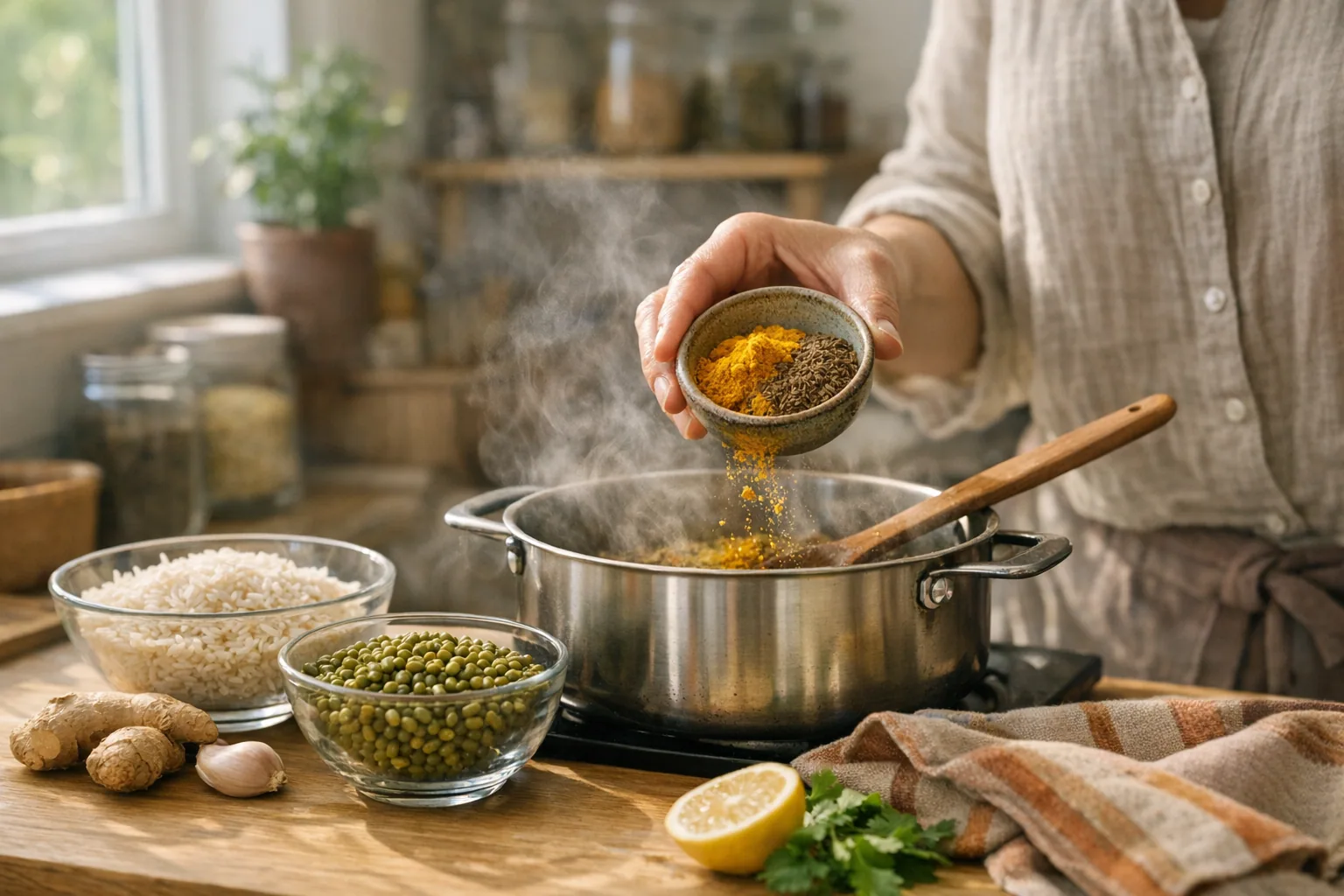
Kitchari, also spelled khichdi, is one of the best-known dishes in Ayurvedic cooking. It is traditionally made with basmati rice, split yellow mung dal, spices and often seasonal vegetables. The result is a soft, creamy stew, somewhere between a thick soup and a loose risotto. In Ayurveda it is valued because it combines a grain and a legume in a simple, warm and generally easy-to-digest meal.
Its value is not that it works like a miracle cleanse. A more realistic way to understand kitchari is as a nourishing, uncomplicated dish that can be adapted to different needs. It can be useful when you want something light but satisfying, after a few days of heavier meals, during colder months, or whenever your digestion prefers simple preparations. Split mung dal has no skin, so many people find it gentler than other legumes, while basmati rice gives the dish a light, aromatic base.
When should you eat it? Kitchari works well as a main dish for lunch or dinner, especially when cooked with suitable vegetables and a moderate amount of fat. Some Ayurvedic routines use it as the main food for one or several days, but you do not need to turn it into a mono-diet to enjoy it. For everyday use, it is best treated as a warm, balanced stew that you can adjust according to season, appetite, digestive tolerance and dosha tendency.
Ingredients with exact quantities
These quantities make 3 generous portions or 4 moderate portions. The final texture is creamy and slightly soupy. If you prefer it thicker, reduce the liquid at the end or let it rest a little longer.
- 150 g white basmati rice
- 120 g split yellow mung dal, also called skinless moong dal
- 1,200 ml hot water or mild vegetable broth
- 20 g ghee, or 20 ml extra virgin olive oil for a plant-based version
- 8 g fresh grated ginger, about 1 level tablespoon
- 5 g cumin seeds, about 1 teaspoon
- 5 g ground coriander seeds, about 1 heaped teaspoon
- 3 g ground turmeric, about 1 level teaspoon
- 1 g ground black pepper, about a generous pinch
- 1 small bay leaf, optional
- 150 g carrot, diced
- 150 g courgette or zucchini, diced or cut into half-moons
- 100 g pumpkin or sweet potato, cut into 1.5 cm cubes
- 6 g fine sea salt, about 1 level teaspoon, adjusted at the end
- 10 ml lemon or lime juice, optional for serving
- 10 g fresh coriander leaves, chopped, optional for serving
Before cooking, rinse the rice and mung dal well. Place them in a bowl, cover with cold water, stir with your hand and drain. Repeat 3 or 4 times, until the water looks less cloudy. If you have time, soak the mung dal for 30 minutes and drain it; this is not essential, but it helps the dal cook evenly and soften well.
Step-by-step preparation
- Rinse the base. Wash the basmati rice and mung dal until the water is clearer. This removes some surface starch and helps the final texture become creamy without turning overly sticky. If you soaked the dal, drain it thoroughly before cooking.
- Prepare the vegetables. Cut the carrot, courgette and pumpkin into small, even pieces. Cubes of 1 to 1.5 cm cook evenly and blend better into the stew. If using harder vegetables such as parsnip or sweet potato, cut them slightly smaller.
- Bloom the spices. Heat a heavy-bottomed pot over medium heat, around 160–170 °C if your hob allows temperature control. Add the ghee and, once melted but not smoking, add the cumin seeds. Cook for 30–45 seconds, until aromatic. Add ginger, turmeric, ground coriander, black pepper and bay leaf, then stir for another 20–30 seconds. The spices should release aroma, not burn.
- Add rice, dal and vegetables. Add the drained rice and mung dal to the pot. Stir for 1 minute so they are coated in the spiced fat. Add the carrot and pumpkin. If you want the courgette to keep more shape, save it for later.
- Add liquid and simmer. Pour in 1,200 ml hot water or mild broth. Bring to a boil, then reduce to low heat. The surface should bubble gently, not boil aggressively. Cook for 25 minutes with the lid slightly ajar, stirring every 8–10 minutes so it does not stick.
- Adjust the texture. Add the courgette and salt, then cook for another 8–10 minutes. Kitchari is ready when the rice has opened, the mung dal is very soft and the whole dish looks creamy. For a soupier texture, add 100–200 ml hot water at the end. For a thicker texture, cook uncovered for 3–5 minutes.
- Rest before serving. Turn off the heat, cover the pot and let it rest for 5 minutes. This helps the flavours settle and the texture come together. Taste and adjust salt before serving.
- Finish with freshness. Add a little lemon or lime juice and chopped fresh coriander if they suit you. The acidity brightens the dish, but it is optional; people with reflux or gastritis may prefer to skip it.
Dosha variations
In Ayurveda, doshas are a traditional way of describing bodily and digestive tendencies. You do not need to apply them rigidly. Use the following variations as practical guidance: more moisture and warmth for dryness or irregularity, less heat for acidity or irritability, and more lightness when there is heaviness.
Vata kitchari: warmer, softer and more soupy
Vata is associated with dryness, coldness, lightness and irregular digestion. For a vata-friendly version, the dish should be moist, well cooked and gently warming. Increase the water to 1,350 ml and use 25–30 g ghee instead of 20 g. You may also add a small pinch of asafoetida if you tolerate it, as it is traditionally used to make legumes easier to digest.
Choose vegetables such as pumpkin, carrot, sweet potato, peeled courgette or cooked fennel. Avoid serving the dish dry or al dente. For vata, kitchari is usually best eaten freshly cooked, warm and spoonable. If legumes tend to give you gas, start with 90–100 g mung dal and increase the rice slightly.
Pitta kitchari: gentle, cooling and less spicy
Pitta is linked to heat, intensity and a tendency towards acidity or irritation. This variation reduces the hotter spices. Use only 4 g fresh ginger, omit black pepper or keep a tiny pinch, and avoid chilli. Keep turmeric and ground coriander, and consider adding 3 g fennel seeds or 2 lightly crushed cardamom pods.
Good vegetables include courgette, green beans, asparagus, mild pumpkin or a small amount of chard added near the end. Serve with fresh coriander and, if you do not have acidity, a few drops of lime. For pitta, avoid eating it boiling hot; warm is better than piping hot.
Kapha kitchari: lighter, more stimulating and less oily
Kapha is associated with heaviness, slowness and a tendency towards congestion or fluid retention. For this variation, reduce ghee to 10 g or use 10 ml olive oil. Lower the rice to 110–120 g and keep 120 g mung dal, or increase the dal to 140 g if you digest it well. Add more stimulating spices: extra ginger, a little more black pepper and, if suitable, a tiny pinch of cayenne.
Choose lighter, less sweet vegetables such as cauliflower, broccoli, spinach, chard, celery or leek. Avoid too much pumpkin, sweet potato and carrot if you want a lighter version. The texture can be slightly less soupy than the vata version, but it should not be dry.
Other practical adaptations
Basic kitchari is naturally gluten-free if all ingredients are certified and cross-contamination is avoided. If you cannot find split yellow mung dal, red split lentils can be used, although the flavour and traditional profile will change. Red lentils break down faster and often need a shorter total cooking time, around 22–28 minutes.
For more protein, add 80–100 g firm tofu cubes during the last 10 minutes of cooking, or serve with plain yogurt if you tolerate dairy and it fits your diet. From a classical Ayurvedic perspective, combining too many protein sources is not always encouraged, but in everyday cooking it can be useful to adjust the dish to your needs. Another option is to increase mung dal to 150 g and reduce rice to 120 g, keeping the liquid around 1,250–1,300 ml.
Storage in the fridge and freezer
Kitchari is best eaten freshly made, when the rice and dal are creamy and the spices are fragrant. Still, it keeps well in the fridge for up to 3 days in an airtight container. Let it cool before storing, but do not leave it at room temperature for more than 2 hours. It will thicken as it cools because the rice and dal continue absorbing liquid.
To reheat, place one portion in a small pot and add 50–150 ml water, depending on how thick it is. Warm over low heat for 5–8 minutes, stirring often. You can also use a microwave, but heat in 1-minute intervals and stir between each one.
Kitchari can be frozen, although the texture will change slightly. Freeze in individual portions for up to 2 months. Defrost overnight in the fridge and reheat with water or mild broth. Avoid freezing batches with too many watery vegetables, as they can become very soft after thawing.
Reasonable benefits of kitchari
The main benefit of kitchari is that it offers a complete meal with few ingredients and a generally gentle digestive profile. The combination of basmati rice and mung dal provides carbohydrates, plant protein and fibre in a balanced way. Spices such as cumin, coriander, ginger and turmeric are traditionally used to support digestive comfort, although their effect depends on quantity, individual tolerance and the rest of the diet.
Kitchari can also help simplify eating for a few meals. After days of heavy food, irregular schedules or too much snacking, a warm and repeatable dish may help regulate appetite. This does not mean it cures illness or detoxifies the body in a medical sense. The liver, kidneys and digestive system already handle elimination; what kitchari can do is replace heavier, ultra-processed or harder-to-digest meals with something simpler.
Precautions: who should be careful
Even though it is a gentle recipe, not everyone tolerates it the same way. People with irritable bowel syndrome, digestive flare-ups, active inflammatory bowel disease or strong sensitivity to legumes should start with small portions. Even skinless mung dal can cause gas if you are not used to legumes. Soaking, rinsing well, cooking until very soft and using cumin or fennel can help.
If you have diabetes or need to manage carbohydrate intake, pay attention to the amount of rice and your portion size. You can increase non-starchy vegetables and reduce rice, but it is best to personalise this with a professional if medication or specific dietary guidelines are involved. During pregnancy, breastfeeding, kidney disease, therapeutic diets or medical treatment, avoid doing several days of kitchari-only eating without supervision.
FAQ
Can I make kitchari with brown rice?
Yes, but it changes both texture and cooking time. Brown rice usually needs more water and around 40–45 minutes, sometimes longer. For a classic, gentler version, white basmati rice is more common. If using brown rice, soak it for 4–8 hours and start cooking it about 15 minutes before adding the mung dal.
Do I have to use ghee?
No. Ghee adds flavour and richness and is widely used in Ayurvedic cooking, but you can replace it with extra virgin olive oil or coconut oil in the same amount. For a lighter version, reduce the fat to 10–15 g. The key is to avoid burning the spices at the beginning.
How many days can I eat kitchari?
As part of a varied diet, you can eat it whenever it suits you. Some Ayurvedic routines use it for 1–3 days as the main food, but that is not necessary or appropriate for everyone. If eating it several days in a row, vary the vegetables and avoid treating it as an extreme diet.
What texture should it have?
The ideal texture is creamy, moist and easy to eat with a spoon. It should not be dry like pilaf rice, nor completely liquid like a thin soup. If it is too thick, add hot water gradually. If it is too liquid, simmer uncovered for a few minutes while stirring often.
Closing
Kitchari is a humble, practical and highly adaptable recipe: rice, mung dal, spices and well-cooked vegetables. With balanced proportions and small adjustments for your digestion, it can become a comforting dish for days when your body asks for warmth, simplicity and steady nourishment.
Ready for your next retreat?
Explore hundreds of retreats across Spain with transparent pricing.
Explore retreats