Hatha Yoga: Origins, Practice and Who It Suits
Retiru Team
The Retiru content team — yoga, meditation and ayurveda.
Introduction
Hatha yoga is often the first contact many people have with yoga. In studios, gyms and online classes, it is usually presented as a steady, accessible practice focused on postures. That description is useful, but incomplete. Traditionally, Hatha yoga refers to a set of physical and breathing techniques designed to prepare the body, regulate attention and create a more stable inner state.
Its popularity comes from the fact that it can be practised without advanced flexibility or athletic ability. Unlike faster styles, it does not rely on continuous flow or cardiovascular intensity. The emphasis is on entering a posture, staying long enough to observe it, adjusting the breath and leaving the posture with control. This makes it suitable for beginners, but also valuable for experienced practitioners who want to refine alignment, breathing and awareness.
A realistic view is important. Hatha yoga may support mobility, posture, strength endurance, stress regulation and body awareness, but it is not a medical treatment or a substitute for physiotherapy when there is an injury. Practised consistently, two or three times per week, it can become a reliable foundation for moving better and breathing with more ease.
What this style is and how it differs
The word Hatha comes from Sanskrit. In modern yoga, it is often explained as ha, associated with the sun, and tha, associated with the moon, suggesting balance between active and receptive qualities. In traditional sources, it is also connected with force or disciplined effort. This does not mean aggression or strain; it points to a steady practice that uses the body and breath as tools for concentration.
Hatha yoga developed in medieval India, with strong links to Nath yogi traditions and texts such as the Hatha Yoga Pradipika, attributed to Svātmārāma and commonly dated around the 15th century. This text systematised practices including asana, pranayama, mudra, bandha and purification techniques. Over time, especially in the 20th and 21st centuries, Hatha became one of the main roots of modern postural yoga as it is practised around the world.
In a contemporary class, Hatha usually includes held postures, simple breathing practices and a final relaxation. It is generally slower than Vinyasa, where postures are linked in a continuous flow, and less fixed than Ashtanga, which follows set sequences. It also differs from Yin yoga: Yin tends to hold passive floor postures for several minutes, while Hatha balances muscular engagement, mobility, breathing and rest.
However, Hatha does not automatically mean easy. A class can be gentle, moderate or physically demanding depending on the postures, how long they are held and the level of the group. Holding a standing posture for 45 to 60 seconds with steady breathing can be challenging. The point is not to rush into intensity, but to work with precision.
Benefits and realistic limits
One of the clearest benefits of Hatha yoga is improved body awareness. When you hold a posture and observe your breathing, you begin to notice habitual tension: raised shoulders, a clenched jaw, locked knees, a compressed lower back or shallow breathing. This awareness can change how you sit, stand, walk and move during the rest of the day.
Hatha yoga may also support mobility and functional strength. Postures such as mountain pose, warrior II, downward-facing dog, bridge and triangle involve the legs, spine, shoulders and core in an integrated way. They do not replace progressive strength training, but they can help maintain joint range, balance and neuromuscular control. For sedentary people, regular practice can make everyday movements feel easier.
The breathing component is equally important. Slow nasal breathing, longer exhalations and simple pranayama can help reduce excessive activation. This does not mean that one class will solve anxiety or chronic stress, but the nervous system does respond to breath rhythm, moderate movement and sustained attention.
There are also limits. Persistent pain, tingling, loss of strength, dizziness or a recent injury should not be managed by guessing modifications. It is better to seek medical or physiotherapy advice and practise with a qualified teacher. Traditional Hatha techniques such as long breath retentions, strong locks or advanced inversions are not appropriate for everyone and should be introduced gradually.
How to practise: a detailed 60-minute sequence
This sequence is designed for people without acute injuries. Practise on a yoga mat and use a blanket and blocks if available. The intensity should feel moderate: muscular effort is fine, but sharp pain, breathlessness or joint discomfort are not.
1. Arrival and initial breathing, 5 minutes
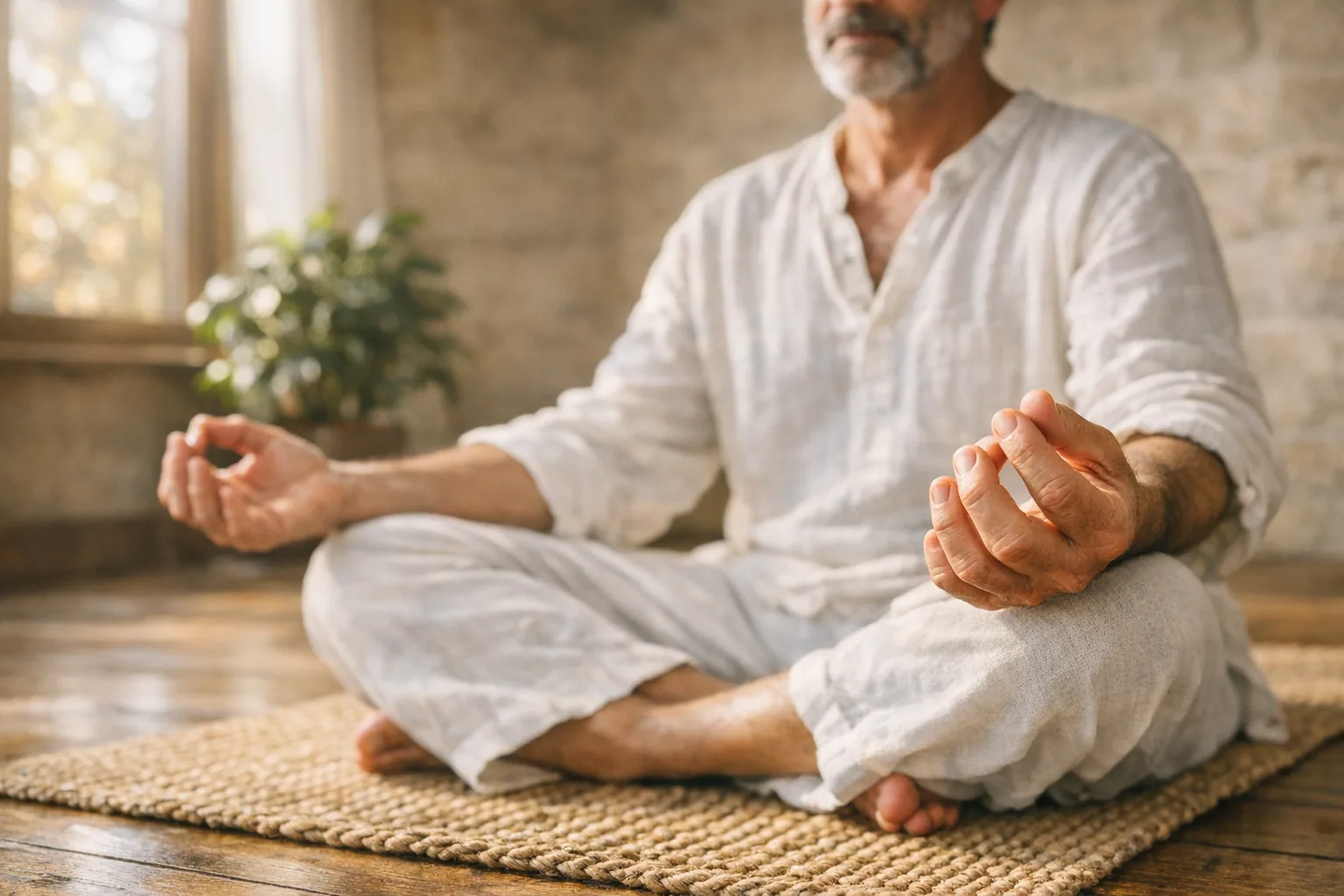
Sit cross-legged on a folded blanket, or on a chair if your lower back rounds. Rest your hands on your thighs and gently close your eyes. For the first two minutes, simply observe your natural breath. Then begin to lengthen the exhalation: inhale through the nose for 4 counts and exhale for 5 or 6 counts. Repeat for around 10 breaths.
The aim is not to create a perfect meditation posture. The aim is to arrive, settle the spine and establish a calm breathing rhythm before movement begins.
2. Gentle joint mobility, 8 minutes
Move the neck slowly, avoiding deep backward drops of the head. Roll the shoulders 5 times forward and 5 times back. Come to all fours and practise cat-cow for 8 to 10 breathing cycles, inhaling as the spine extends and exhaling as it rounds. Add gentle wrist and ankle movements, especially if you spend many hours sitting.
Then move back into a soft child’s pose for 5 breaths. If your knees are uncomfortable, place a folded blanket behind them or widen the knees. This phase is not about maximum stretching; it is about preparing the joints and waking up the muscles.
3. Gentle sun salutations, 8 minutes
Practise 3 to 4 rounds of a simplified sun salutation. From mountain pose, inhale and raise the arms; exhale and fold forward with bent knees; inhale to lengthen the spine halfway; exhale and step back to a modified plank with knees down; lower slowly to the floor; inhale into low cobra; exhale back to downward-facing dog or child’s pose. Walk forward and repeat.
Keep the pace slow. Each transition should take a full breath. If downward-facing dog puts too much pressure on the wrists or shoulders, use child’s pose or a tabletop variation instead.
4. Standing postures, 12 minutes
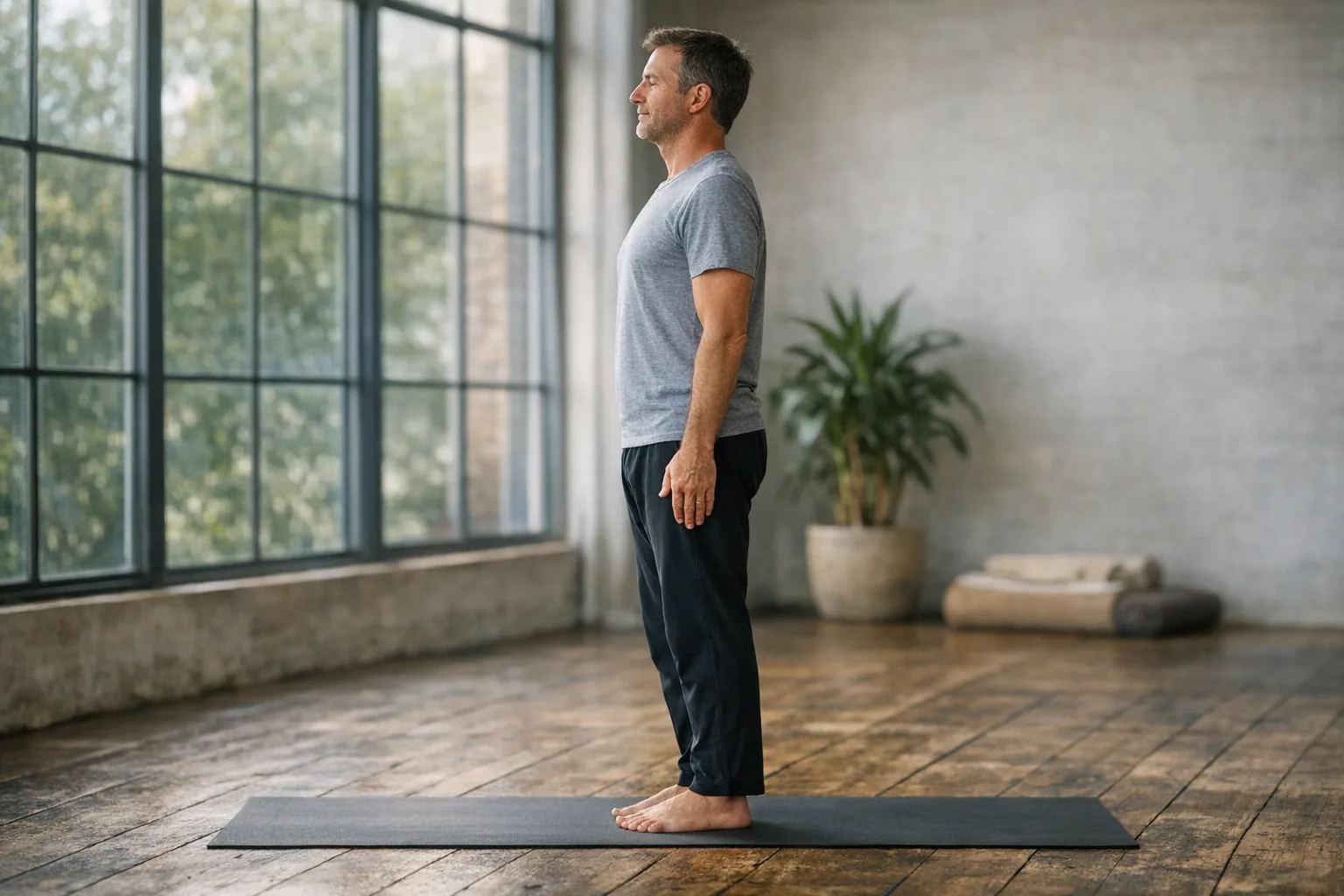
Start with mountain pose for 1 minute, spreading weight through the heel, the base of the big toe and the base of the little toe. Practise warrior II for 5 breaths on each side, keeping the front knee aligned toward the second or third toe. Continue with triangle pose, using a block under the lower hand if needed, and stay for 4 to 5 breaths on each side.
Add a simple balance posture such as tree pose for 30 to 45 seconds per side. Place the foot on the ankle, calf or inner thigh, but not directly against the knee. The goal is not to be perfectly still; it is to return to centre whenever the body wobbles.
5. Floor work, 15 minutes
Lie on your back and hug the knees to the chest for 5 breaths. Practise bridge pose with the feet hip-width apart: inhale to lift the pelvis and exhale to lower. Do 3 dynamic repetitions, then hold a comfortable bridge for 5 breaths.
Move into a supine twist, letting the knees fall to one side and turning the head in the opposite direction if your neck allows it. Stay for 1 minute per side. Then practise a seated forward fold with slightly bent knees and a blanket under the pelvis if the lower back rounds strongly. Stay for 8 to 10 breaths without pulling aggressively on the feet.
6. Simple pranayama, 5 minutes
Sit again and practise alternate nostril breathing without retention. Gently close the right nostril and inhale through the left; close the left and exhale through the right; inhale through the right; change sides and exhale through the left. Continue for 3 to 5 minutes with an easy breath.
Avoid holding the breath if you are new to pranayama, pregnant, have uncontrolled high blood pressure or feel anxious when breathing practices are introduced. The breath should leave you clearer, not more tense.
7. Final relaxation, 7 minutes
Finish in savasana, lying on your back. Place a blanket under the knees if the lower back feels tight. Let the breath return to its natural rhythm. Mentally scan the body from feet to face, releasing unnecessary effort.
Do not jump up immediately. Roll to one side, pause for a few breaths and return to sitting slowly. This final step helps the nervous system integrate the practice.
Common beginner mistakes
The first mistake is confusing depth with quality. Going further into a pose does not mean practising better. If a forward fold makes you hold your breath or strain the hamstrings, bend the knees and use support. A good posture is stable, breathable and adjustable.
Another common mistake is copying the outer shape without listening to the body. Two people may need different versions of the same pose because of anatomy, strength, mobility or previous injuries. The teacher’s form is a reference, not a rule that overrides sensation.
Many beginners also breathe too little. They hold the breath in warrior, plank or balance poses without noticing. If the breath becomes rough, reduce the intensity, shorten the hold or use a prop. Three to five calm breaths are often more useful than a long hold filled with tension.
Who it suits and contraindications
Hatha yoga is generally suitable for beginners, people with moderate stress, those who sit for long periods and practitioners who want a technical base before trying faster styles. It can also work well for older adults when adapted with chairs, props and slow transitions.
It should be adapted during pregnancy, especially after the first trimester. Deep abdominal compression, closed twists, breath retention and unfamiliar inversions are best avoided. People with uncontrolled high blood pressure, glaucoma or cardiovascular conditions should avoid long retentions, strong inversions and intense effort without guidance.
If you have disc issues, sciatica, osteoporosis, knee injuries, shoulder pain or are recovering from surgery, individual adaptation is essential. Deep forward folds, forced twists and long weight-bearing positions on the wrists may aggravate symptoms. Stop if you feel dizziness, nausea, blurred vision, radiating pain or loss of control.
Suggested weekly routine
Three weekly sessions are enough to start. On Monday, practise 45 to 60 minutes with standing postures and breathing. On Wednesday, do a gentler 25 to 35 minute session focused on spinal, hip and shoulder mobility. On Friday or Saturday, practise 45 minutes including balance, bridge, gentle twists and a longer relaxation.
On the days between, a 20 to 30 minute walk and 5 minutes of slow nasal breathing can support the practice. You do not need to practise intensely every day. Alternating moderate and gentle sessions helps avoid overload and makes consistency easier.
If you only have 15 minutes, keep it simple: 2 minutes of breathing, 5 minutes of mobility, 5 minutes of basic postures and 3 minutes of relaxation. Consistency matters more than duration.
FAQ
Does Hatha yoga improve flexibility?
Yes, but flexibility improves through regular, intelligent practice, not forcing. Props, bent knees and shorter holds are not signs of weakness; they create the conditions for safe progress.
Is Hatha or Vinyasa better for beginners?
Hatha is often easier to start with because the pace allows time to understand the postures. Vinyasa can be excellent, but it requires faster coordination of movement, breath and transitions.
How long should I hold each pose?
For most beginners, 3 to 8 breaths is enough. Standing postures may be held for 30 to 60 seconds, while comfortable floor postures can be held for 1 to 2 minutes.
Can I practise Hatha yoga every day?
Yes, if you vary the intensity. Daily practice can be as simple as 20 minutes of mobility, breathing and relaxation. If you feel joint pain or fatigue, choose a restorative session or rest.
Closing
Hatha yoga is a broad practice with ancient roots and very practical modern uses. Its value lies in the combination of posture, breath and attention, not in impressive shapes. Practised with patience and appropriate adaptation, it can support beginners and experienced practitioners alike.
The essential attitude is simple: less rushing, more listening; less comparison, more consistency. That is where the real practice begins.
Ready for your next retreat?
Explore hundreds of retreats across Spain with transparent pricing.
Explore retreats