Ashtanga: fixed series, discipline and progression
Retiru Team
The Retiru content team — yoga, meditation and ayurveda.
Introduction
Ashtanga is one of the most recognisable yoga styles because the sequence does not change from one class to the next. You practise a fixed order of postures, link movement with breath and progress gradually through a clear structure. For some people, this feels freeing: there is less improvisation and more opportunity to observe real changes over time. For others, it can feel strict or physically demanding, especially when it is approached as a race towards advanced postures.
The key is to understand that Ashtanga is not just a list of difficult asanas. It is a method in which repetition has a purpose: refining the breath, regulating effort, recognising physical patterns and training attention. The fixed series acts as a map. It does not ask you to move fast; it asks you to return to the same territory with more awareness, patience and precision.
This guide focuses on modern Ashtanga Vinyasa Yoga, systematised by Sri K. Pattabhi Jois from teachings associated with T. Krishnamacharya. It should not be confused with Patanjali’s ashtanga, the classical eight-limbed path of yoga. Here we are talking about a dynamic, structured and physically demanding postural method.
What this style is and how it differs
Ashtanga Vinyasa Yoga is built around three practical elements: breath, posture and gaze. The breath is usually nasal, audible and steady; movement is linked to it through vinyasa; and the gaze, or drishti, helps stabilise attention. The method also uses bandhas, subtle internal actions that support the pelvis, lower abdomen and spine.
Its most distinctive feature is the fixed sequence. The Primary Series, traditionally called Yoga Chikitsa, is organised into clear sections: sun salutations, standing postures, seated postures, finishing postures and rest. In the traditional format, practice begins with five rounds of Surya Namaskar A and five rounds of Surya Namaskar B. Then come standing poses, forward folds, hip openings, twists, backbends and closing postures.
Unlike many contemporary Vinyasa classes, where the sequence changes according to the teacher or theme, Ashtanga keeps the same architecture. Compared with gentle Hatha or Yin yoga, it is more dynamic and can be physically intense. And unlike freer styles, progression is not based on doing more every day, but on integrating each posture before adding the next one.
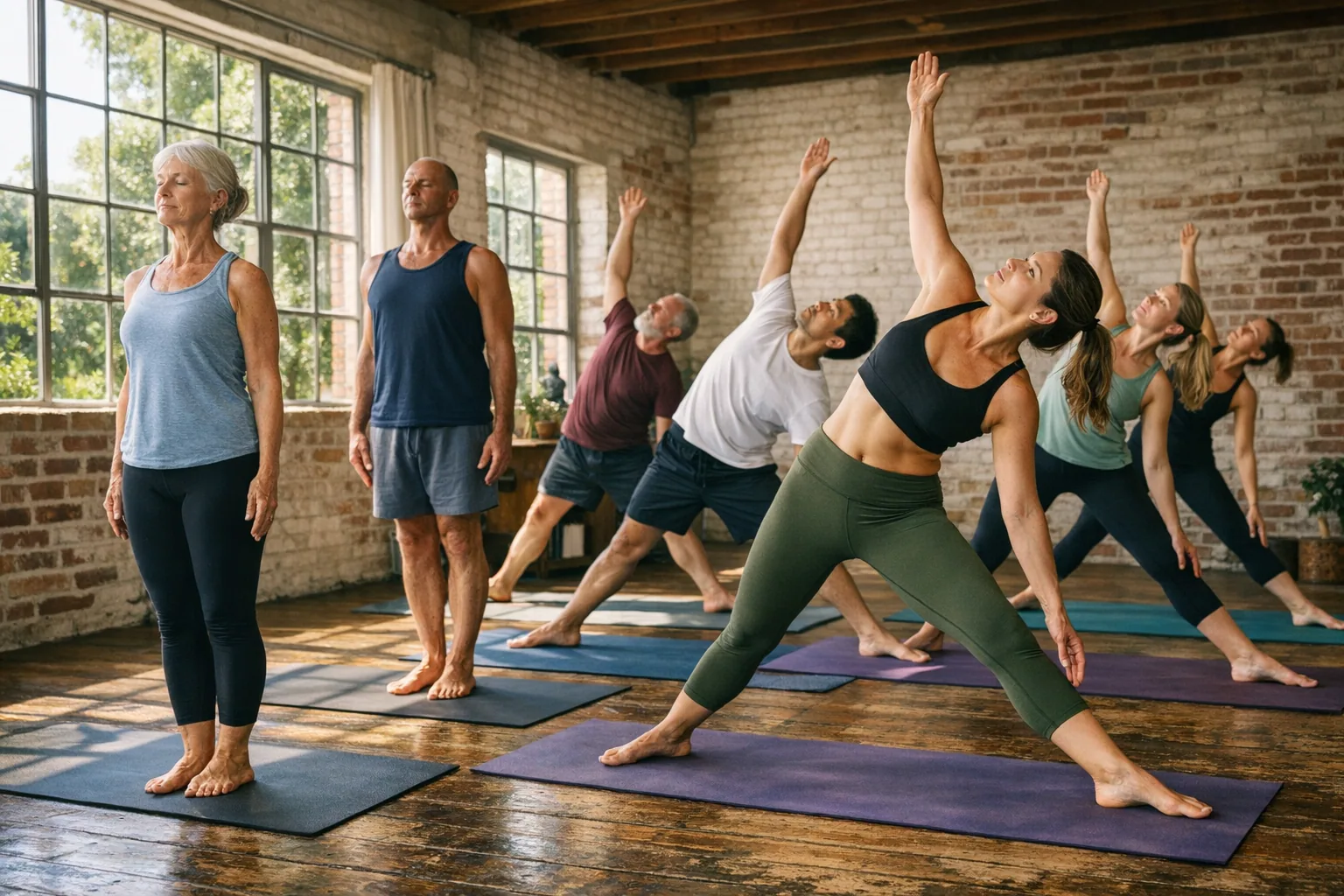
There are two common class formats. In a led class, the teacher counts the rhythm and everyone moves together. In Mysore-style practice, each student practises at their own pace within the same sequence, receiving individual guidance and gradually memorising the order. For beginners, Mysore may look intimidating at first, but when taught well it can be one of the safest ways to learn because the method is adapted to the individual.
Benefits and realistic limits
The first benefit of Ashtanga is clarity. Because the sequence is repeated, it becomes easier to notice what changes: steadier breathing, less fatigue in sun salutations, more hip mobility, or a more controlled transition. Repetition also builds discipline without depending on daily motivation. The practice becomes a stable reference point rather than a constantly new experience.
Physically, Ashtanga can improve strength, endurance, coordination and active flexibility. Sun salutations raise body temperature and prepare the shoulders, legs and spine. Standing postures develop grounding, balance and stability. Seated postures work deeply with the posterior chain, hips and spinal mobility. The finishing sequence, when adapted properly, helps the body move towards a calmer state before rest.
Mentally, the method supports concentration and effort regulation. Once the sequence is memorised, the mind no longer waits for constant external instruction. You can observe the quality of the breath, unnecessary tension and impatience more clearly. That familiarity is useful: when you know what comes next, you can study how you respond to difficulty.
However, the limits should be clear. Ashtanga is not a universal cure for stress, back pain or anxiety. It does not “detox” the body in a medical sense, even though traditional language may describe the Primary Series in those terms. Its benefits depend on consistency, technique and intelligent adaptation. Practised with haste, competitiveness or persistent pain, it can increase strain in the wrists, shoulders, hamstrings, knees or lower back.
How to practise: detailed sequence with timings
A full Primary Series practice may take 75 to 90 minutes, sometimes longer when the breath is slow and all vinyasas are included. A beginner does not need to do the full series. A well-breathed 35 to 45 minute practice is more useful than a long session performed with exhaustion and poor technique.
Beginner practice: 35 to 45 minutes
Start with 3 to 5 minutes of arrival. Stand in Samasthiti or sit comfortably, observe nasal breathing and soften the jaw, shoulders and abdomen. Do not force an intense breath; look for a rhythm you can sustain.
Continue with 10 to 12 minutes of sun salutations. Instead of the traditional five A and five B, begin with 3 rounds of Surya Namaskar A and 2 or 3 rounds of Surya Namaskar B. Prioritise hand placement, shoulder stability in plank and safe transitions into Chaturanga. If Chaturanga is not stable, lower the knees or come all the way to the floor.
Spend 12 to 15 minutes on standing postures. Work with accessible versions of Padangusthasana, Padahastasana, Trikonasana, Parsvakonasana, Prasarita Padottanasana and Parsvottanasana. Stay for about 5 breaths in each posture. Depth is not measured by touching the floor; it is measured by breathing steadily while maintaining support and attention.
Add 8 to 10 minutes of basic seated postures. Dandasana, Paschimottanasana, Janu Sirsasana A and a simple twist are enough at the beginning. Use props if the pelvis rolls backwards or the hamstrings pull strongly. In forward folds, lengthen the spine before folding and avoid bouncing.
Finish with 5 to 8 minutes of closing. Practise a gentle bridge, an accessible inversion such as legs up the wall if you do not do shoulderstand, and at least 5 minutes of Savasana. Rest is not optional; it allows the breath and nervous system to absorb the practice.
More traditional practice
In the traditional structure, the opening includes 5 Surya Namaskar A and 5 Surya Namaskar B, usually taking 12 to 18 minutes depending on breath rhythm. Standing postures may take another 20 minutes. The seated sequence, especially when vinyasas are included, can take 30 to 40 minutes. Finishing postures and Savasana add 10 to 15 minutes.
Progression does not mean learning the whole series at once. In many Mysore rooms, the teacher gives a new posture only when the previous one is stable enough. Stable does not mean visually perfect; it means breathable, safe and understood. Sometimes the wisest progression is to repeat fewer postures for months while the body builds strength and mobility.
Common beginner mistakes
A common mistake is confusing discipline with hardness. Consistency does not mean ignoring pain, competing with others or repeating Chaturangas when the shoulders are no longer well supported. Useful discipline is the kind that allows you to practise tomorrow, not the kind that exhausts you today.
Another mistake is moving too quickly through the series. Watching full Primary Series videos may create the idea that doing Ashtanga means completing every posture. In reality, a partial practice is still Ashtanga if it respects breath, order, attention and adaptation. Skipping the foundation stage often shows up later in the knees, lower back or wrists.
It is also common to sacrifice breathing for external shape. If you stop breathing smoothly, tighten the face or brace the abdomen aggressively, the posture probably needs modification. In Ashtanga, breath is the metronome of practice. When it is lost, reduce intensity, use blocks, bend the knees or come out earlier.
A fourth mistake is practising at maximum intensity every day. The fixed sequence does not require the same output every time. Sleep, stress, the menstrual cycle, food, recent injury and workload all affect the body’s real capacity. Adapting is not a failure of the method; it is a sign of intelligent practice.
Who it suits and contraindications
Ashtanga may suit people who like structure, want to develop self-practice and respond well to repetition. It can also be useful for those looking for a combination of strength, mobility and concentration, provided they are willing to progress gradually. Athletes, experienced yoga practitioners and people with good tolerance for physical effort often appreciate the method.
It is not the best first option for everyone. If you have an acute shoulder, wrist, knee, hip or lower back injury, seek professional advice and work with a qualified teacher before practising dynamic sequences. With uncontrolled high blood pressure, glaucoma, significant cardiovascular conditions or pregnancy, inversions, jumping, breath retention and strong effort need careful review. After childbirth or abdominal surgery, progression should be very gradual.
Caution is also important if you have a compulsive relationship with exercise. The structure of Ashtanga can be positive, but for some people it may reinforce excessive self-demand. If you feel anxious about not completing the series, guilty for resting or tempted to practise through pain, reduce frequency and seek guidance.
A practical rule is simple: tolerable muscular effort may be part of learning; sharp pain, joint pain, tingling, loss of strength or pain that worsens after practice should not be normalised. In those cases, modify or stop.
Suggested weekly routine
Traditional Ashtanga often refers to frequent practice, sometimes six days per week, with one rest day and pauses on moon days in some schools. Beginners do not need to start there. Consistency is better built with a sustainable dose.
A solid starting point is 3 days per week for 35 to 45 minutes. For example: Monday, Wednesday and Friday with a partial sequence; Tuesday or Thursday with gentle mobility, walking or breathing; and the weekend for rest or a quieter session. After 6 to 8 weeks, if there is no pain or accumulated fatigue, add a fourth shorter practice of 25 to 30 minutes.
For intermediate practitioners, a balanced week may include 3 complete or semi-complete practices of 60 to 75 minutes, 1 shorter practice focused on sun salutations and standing postures, and 2 days of active rest. If you notice irritability, poor sleep, persistent wrist pain or tiredness before starting, reduce volume before adding intensity.
A reasonable progression over the first months is: first memorise sun salutations and standing postures; then add basic seated forward folds; later include hip work and twists; and only afterwards explore more demanding finishing postures. There is no rush. In Ashtanga, repeating a simple posture with steady breath often teaches more than collecting advanced shapes.
FAQ
Do I have to practise every day to do Ashtanga?
No. The traditional practice is frequent, but beginners can progress with 3 weekly sessions if they are consistent. The frequency should not exceed your recovery capacity. A sustainable practice for a year is more valuable than six excessive weeks.
Can I do Ashtanga if I am not flexible?
Yes, if you are willing to adapt. Flexibility is not a prerequisite; it develops over time through strength, breath and repetition. Bending the knees, using blocks or shortening a posture does not reduce the value of the practice.
What is the difference between led class and Mysore?
In a led class, everyone follows the teacher’s count and rhythm. In Mysore, each person practises the memorised sequence at their own pace and receives individual guidance. Combining both can be useful: led classes teach rhythm and structure, while Mysore allows adaptation.
When can I move to Second Series?
Second Series, called Nadi Shodhana, is more demanding and includes deeper backbends, openings and balances. It should not be rushed. The transition is best made with an experienced teacher, when Primary Series is integrated, the breath remains steady and there are no active injuries.
Closing
Ashtanga is a direct, demanding and honest practice: it quickly shows where there is strength, where there is restriction and where impatience appears. Its value is not in completing a perfect series, but in returning to the same sequence with more attention and less hurry. Discipline, in this context, is not rigidity; it is care repeated intelligently.
If you are starting, begin with a partial sequence, good guidance and realistic expectations. Breathe before progressing, modify before forcing and rest before breaking continuity. That is how the fixed series becomes a clear tool for growth rather than an obligation.
Ready for your next retreat?
Explore hundreds of retreats across Spain with transparent pricing.
Explore retreats