Brahmi Gotu Kola Oil: Head Massage and Focus Uses
Retiru Team
The Retiru content team — yoga, meditation and ayurveda.
Introduction
Brahmi gotu kola oil is one of the best-known Ayurvedic oils for head care, scalp massage and mental calm. It is not a miracle product for memory, nor a shortcut to perfect focus, but it can be a useful part of a routine that helps the body slow down and the mind settle. Its most common use is external: applied to the scalp, temples, crown of the head, neck and sometimes the hair.
A first clarification is essential. The word Brahmi is used in different ways. In many Ayurvedic contexts it refers to Bacopa monnieri, while in other products it is linked to gotu kola, also known as Centella asiatica. Both plants have traditionally been associated with mental clarity, learning, memory and the nervous system, but they are not identical. In this guide, we focus on Brahmi oil with gotu kola as a topical massage oil, not as an oral supplement.
Used wisely, this oil can become a practical transition ritual: from work to rest, from screen time to sleep, or from distraction to a more focused study session. Its benefits are best understood through the combined effects of touch, warmth, gentle pressure, scent, repetition and a conscious pause. That makes it valuable, but also calls for realistic expectations.
What it is in the Ayurvedic tradition
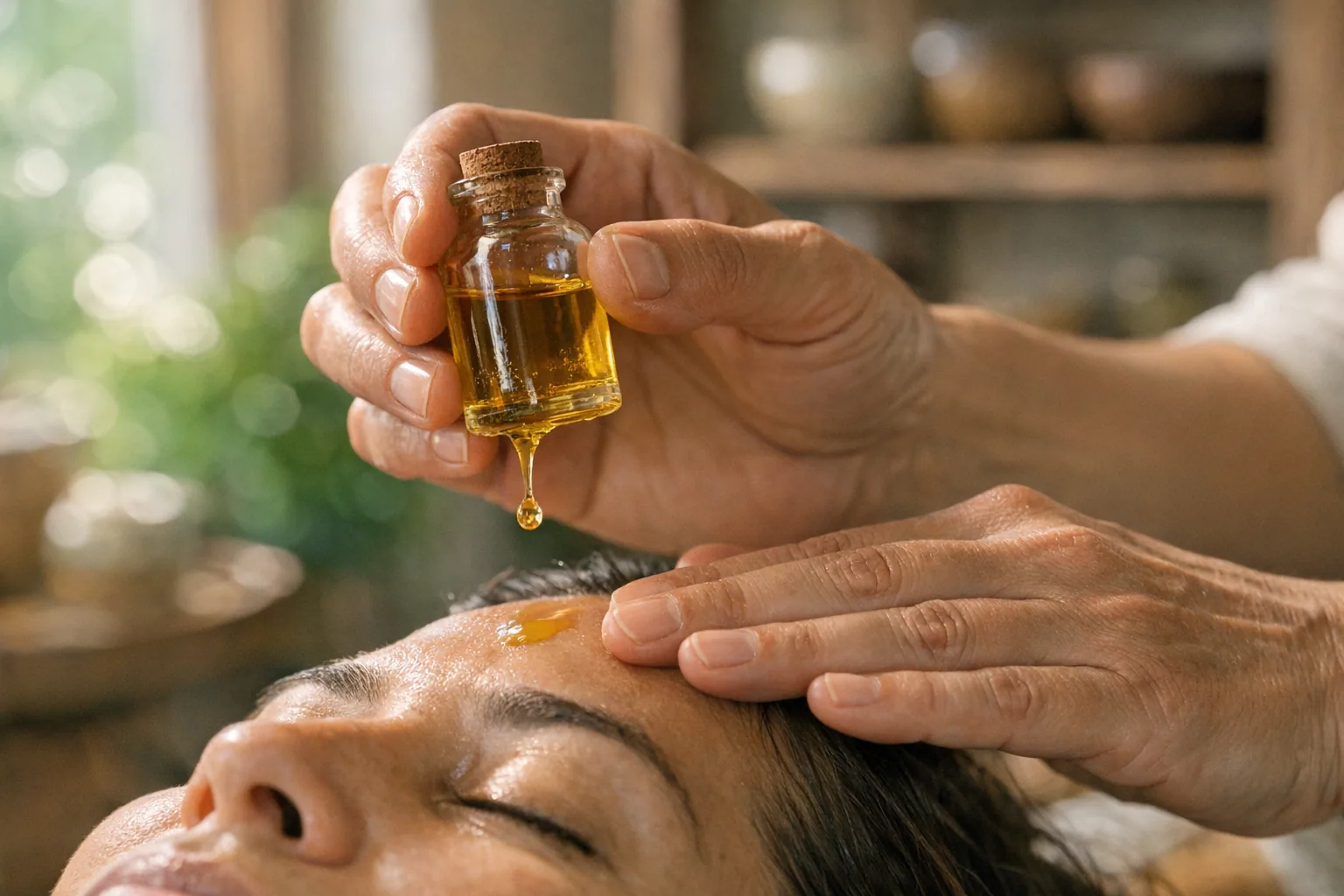
In Ayurveda, herbal oils are often prepared by combining a vegetable oil base with plant extracts or decoctions. Sesame oil, coconut oil and other carrier oils are commonly used, depending on the desired qualities and the person’s constitution. Brahmi oil is traditionally used in treatments involving the head, scalp and nervous system, especially in massage practices such as shiro abhyanga, or Ayurvedic head massage.
Gotu kola, or centella asiatica, is a respected plant in several herbal traditions. In Ayurveda it is associated with calmness, mental clarity and balance. In modern herbal and wellness contexts, it is also discussed for potential roles in cognitive support, mild anxiety, skin health, inflammation and venous circulation. However, topical application and oral supplementation are very different. An oil applied to the scalp should not be treated as equivalent to capsules or concentrated extracts.
The head, neck and jaw tend to accumulate tension from screens, long hours of concentration, poor posture and stress. Warm oil reduces friction and allows the hands to move slowly across the scalp and temples. From a contemporary perspective, much of the effect may come from nervous system downshifting: slower breathing, pleasant pressure, warmth and a clear signal that the day is changing pace.
You do not need to adopt every Ayurvedic concept literally to use the oil sensibly. It can be approached as a body-based self-care tool. The important point is not to claim guaranteed medical effects or to replace psychological, neurological or dermatological care when those are needed.
Main uses and attributed benefits
The most common use of Brahmi gotu kola oil is to calm the mind. Many people apply it in the evening when they feel mentally overloaded, overstimulated or tense from long periods of work. A slow scalp and temple massage can help release superficial tension and create a sense of grounding. It does not “cure” anxiety, but it can support a broader rest routine.
It is also used as a support for focus and mental clarity. This should be understood carefully. The oil does not directly switch on concentration. Instead, a short massage can mark the beginning of a focused period: phone away, workspace cleared, breath slowed and attention gathered. For some people, the best focus benefit comes not before work but the night before, by helping create a calmer pre-sleep routine.
For hair and scalp care, Brahmi oil is traditionally used to nourish the scalp, soften dry hair and reduce the feeling of tightness. Some products describe it as strengthening for the hair, but it is important to be cautious. Hair loss may be linked to hormones, nutrition, inflammation, medication, stress or genetics. An oil may improve comfort and shine, but it is not a stand-alone treatment for alopecia or active scalp disease.
Another practical use is for tension around the forehead, temples, jaw and neck. Gentle self-massage can make you aware of areas where you hold stress. Pressure should always feel pleasant, never painful. If you have frequent migraines, severe headaches, dizziness, visual symptoms or new unexplained pain, seek medical advice instead of relying on oil massage.
How to apply it: quantity, massage, time and temperature
For home use, start with a small amount. Around 5 ml is usually enough for a light scalp and temple massage. If you want to oil the hair more thoroughly, use 10 to 15 ml, adjusting for hair length and thickness. More is not necessarily better; too much oil can make washing difficult and may irritate some scalps.
The oil should be warm, not hot. A good range is about 37–40 °C, close to body temperature. Warm it gently in a water bath and test a drop on the inside of your wrist before applying it to your head. It should feel comfortable, never burning. Avoid uncontrolled microwave heating, as it can create hot spots.
Begin at the crown of the head, then move to the sides, hairline, temples and nape of the neck. Use fingertips rather than nails, making slow circular movements. For relaxation, spend 10 to 20 minutes. Before studying or working, keep it shorter: 5 to 7 minutes with only a few drops is usually enough. On the temples, use very light pressure, especially if you are headache-prone.
After the massage, leave the oil on for 30 to 60 minutes before washing. Some people leave it overnight, but this is not always ideal. It can stain bedding, feel heavy or irritate sensitive skin. If you do leave it overnight, use a washable towel or pillowcase and avoid over-applying. To remove it, shampooing before fully soaking the hair can help break down the oil more effectively.
For focus, try a simple sequence: 5 minutes of massage, wash your hands, 3 minutes of quiet nasal breathing, then a 25- to 45-minute focused work session. For rest, choose a longer massage, a warm shower and no screens afterward. The oil works best when the surrounding routine supports the same intention.
Choosing according to dosha or season
In Ayurveda, the oil is chosen not only by the herb but also by its base and the person’s current state. People who feel dry, cold, restless, mentally overactive or prone to light sleep are often described as having more Vata qualities. For them, sesame-based oils and warm evening application may feel especially soothing.
Those who tend toward heat, irritability, scalp sensitivity or redness may be described as having more Pitta qualities. In such cases, lighter or more cooling bases, such as coconut, are sometimes preferred. The massage should be gentle, without strong friction, and the oil should not be hot. If there is visible inflammation, dermatitis or strong itching, avoid experimenting and seek professional advice.
People with oilier scalps, heaviness or sleepiness may relate more to Kapha qualities. They often do better with less oil, shorter contact time and application before washing the hair rather than before work. A heavy oil massage in the morning may increase sluggishness for some.
Season also matters. In winter, warm oil can feel deeply comforting. In summer, smaller amounts and shorter applications may be more comfortable. The best guide is your actual response: the scalp should feel calm, the mind clearer and the body not weighed down.
Precautions and when to consult a professional
Natural does not always mean suitable for everyone. Before first use, do a patch test: apply a small amount behind the ear or on the inner forearm and wait 24 hours. If redness, itching, burning, bumps or irritation appear, do not use it on your scalp.
Avoid applying the oil to wounds, infections, active eczema, psoriasis flare-ups, sunburn or broken skin. Check the label for essential oils, especially if you are sensitive or if the formula may contain photosensitising ingredients. If you are pregnant, breastfeeding, taking sedative medication, managing a neurological or liver condition, or using dermatological treatments, ask a qualified professional before regular use.
Oral gotu kola products have their own safety considerations, interactions and dosage issues. This guide concerns topical oil only. If your goal is to address memory problems, anxiety or poor concentration in a clinical sense, look at sleep, stress, nutrition, medication and mental health with professional support.
Overuse can also be a problem. Applying large amounts every day may clog or irritate the scalp in some people. For most, 1 to 2 times per week is enough. If used as a mini focus ritual, use only a few drops and avoid leaving residue.
At home vs in a professional setting
Self-massage at home is accessible, affordable and easy to repeat. With 10 minutes, a small amount of oil and a quiet space, you can create a reliable routine for slowing down. It also helps you learn where you hold tension and how your scalp responds.
A professional Ayurvedic or head massage session can offer more complete support. A trained practitioner can work with the scalp, neck, shoulders and upper back, adjust pressure and select an oil more carefully. The main difference is not mystery, but technique, protected time and the ability to receive without having to guide the process yourself.
If you go to a centre, ask what oil is used, whether it contains essential oils, and whether the practitioner is trained in contraindications. Tell them about migraines, pregnancy, skin conditions, recent surgery or neck issues. A good treatment should not be painful or leave you feeling unwell.
FAQ
Does Brahmi gotu kola oil improve memory?
Traditionally, Brahmi and gotu kola are linked with memory and clarity. As a topical oil, its role is more indirect: relaxation, reduced tension, better routines and a calmer state for learning or rest. It should not replace medical assessment for cognitive changes.
Can I use it before studying?
Yes, but use very little. A few drops on the temples, hairline and nape for 5 minutes can work well as a starting ritual. Too much oil may feel heavy or distracting. Pair it with slow breathing and a distraction-free work block.
Is overnight application better?
Not always. Leaving it on for 30 to 60 minutes is enough for many people. Overnight use may suit dry scalps, but it can also irritate sensitive skin or make hair feel greasy. Start with shorter applications.
Can it help with hair loss?
It may improve scalp comfort and the appearance of dry hair, but it is not a treatment for hair loss. Sudden, patchy or intense shedding should be assessed by a dermatologist.
Closing
Brahmi gotu kola oil is best understood as a simple, grounded Ayurvedic head-care tool. Its strength lies in warm oil, slow touch, repetition and the pause it creates, not in exaggerated claims. Used moderately and with attention to skin tolerance, it can support rest, scalp comfort and more focused transitions in daily life.
Ready for your next retreat?
Explore hundreds of retreats across Spain with transparent pricing.
Explore retreats