Prebiotic-Rich Foods: What They Are and How to Include Them (Without Complicating Things)
Retiru Team
The Retiru content team — yoga, meditation and ayurveda.
Prebiotic-Rich Foods: What They Are and How to Include Them (Without Complicating Things)
If you’re interested in taking care of your digestion, feeling less heaviness, or simply supporting your well-being from the basics, prebiotics are a good place to start. They are not “bacteria” like probiotics: they are mainly fibers and plant compounds that your body doesn’t fully digest and that serve as food for certain beneficial bacteria in your gut.
In this guide, you’ll find foods rich in prebiotics, how to include them in daily life, and useful precautions if they upset you (which is quite common when fiber intake is increased suddenly).
What Are Prebiotics? (In One Clear Sentence)
According to the consensus of the International Scientific Association for Probiotics and Prebiotics (ISAPP), a prebiotic is a substrate that is selectively utilized by host microorganisms and confers a health benefit. In everyday practice, this means: certain fermentable fibers that feed your microbiota.
Important: In Europe, the EFSA is strict with health claims about “prebiotics.” That’s why you will often see the term “fiber” on labels, rather than direct promises.
The Best Foods Rich in Prebiotics (and How to Eat Them)
- The Garlic and Onion Family (high in inulin and FOS)
Garlic, onion, leek, spring onion. These are among the best-known prebiotics for their content of inulin and fructooligosaccharides (FOS).
How to include them without excess:
- Gentle sofrito (onion + leek) as a base for vegetables, legumes, or rice.
- Roasted garlic (more digestible for some people) in creams or spread on bread.
- Artichoke and Chicory (very rich in inulin)
- Artichoke (fresh or good quality canned).
- Chicory root (common in chicory coffee and as inulin fiber added to some products).
Practical idea: sautéed artichokes with lemon and parsley or in vegetable medley; chicory is better as an occasional intake if you’re sensitive to gas.
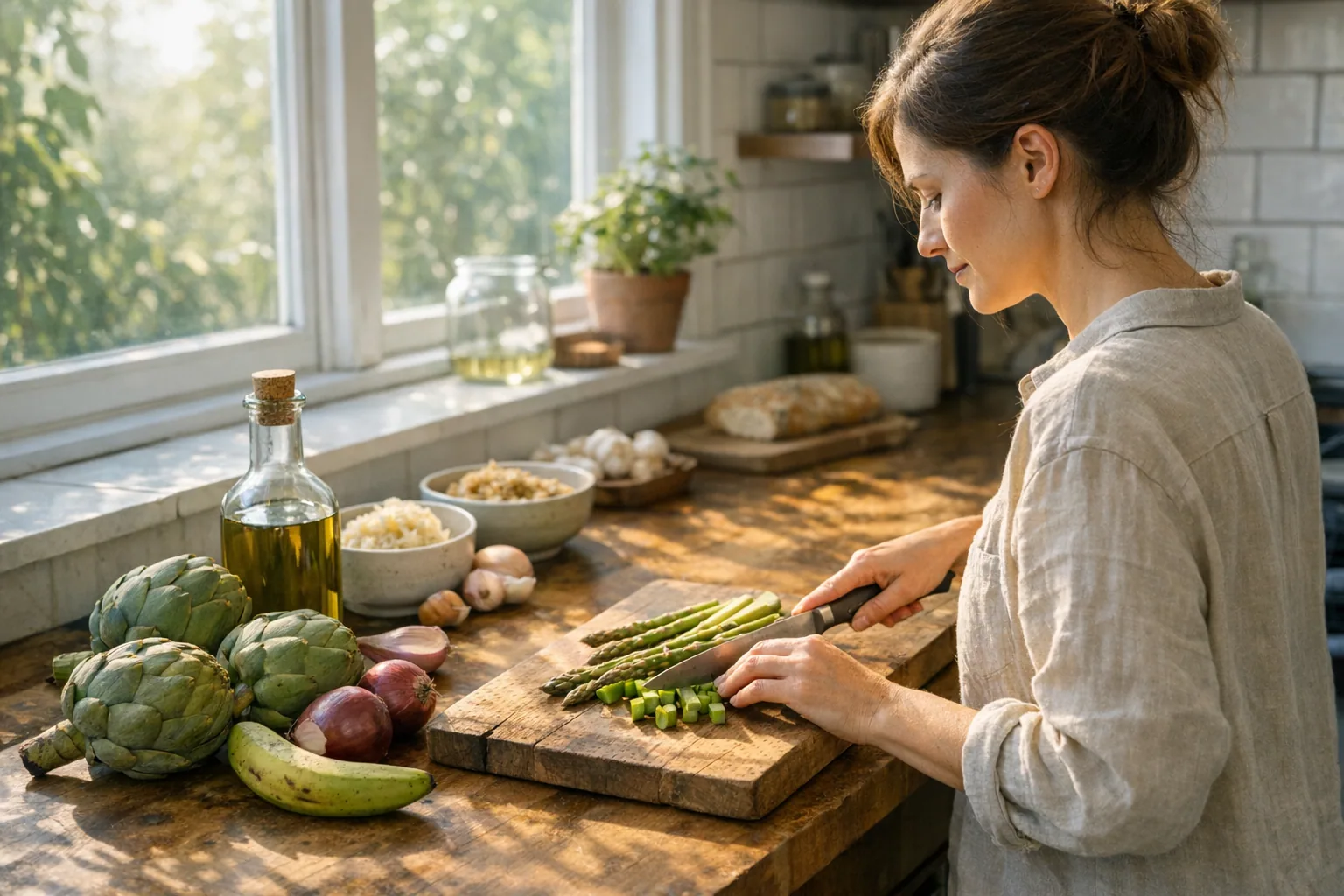
- Asparagus, Mushrooms, and Leafy Greens (varied fermentable fiber)
Asparagus (especially), and also chard, spinach, and some mushrooms provide fibers that can act as substrate for microbiota.
Practical idea: asparagus omelet, quick sauté with olive oil, or warm cream soup.
- Banana (less ripe) and Apple (pectins)
- Slightly green banana: provides more resistant starch (a type of fiber that reaches the colon).
- Apple: rich in pectins.
Tip: if you want a stronger prebiotic effect with banana, choose a less ripe one; if that’s hard, mix half a banana into yogurt or kefir.
- Oats and Barley (beta-glucans)
Oats and barley are interesting for their beta-glucans, soluble fibers related to good general tolerance and satiety effect.
How to eat them:
- Porridge with oats + cinnamon + fruit.
- Bread or “overnight oats” if you want something easy for workdays.
- Legumes (GOS and high total fiber)
Chickpeas, lentils, beans: provide galactooligosaccharides (GOS) and lots of fiber. They are a staple of the Mediterranean diet.
To improve tolerance:
- Long soaking, good cooking.
- Start with small portions.
- More digestible versions: peeled red lentils, smooth hummus.
- “Cooled” Potato and Rice (resistant starch)
When you cook potato, rice, or pasta and cool them down, part of the resistant starch increases (due to “retrogradation”). No need to obsess: it’s a simple tool.
Practical idea:
- Boiled and cooled potato salad (kind of “warm”).
- Rice cooked the day before, sautéed with vegetables.
- Nuts and Seeds (fiber support)
They are not “the most prebiotic” by themselves like garlic or artichoke, but pistachios, almonds, chia seeds, or flaxseeds add fiber and plant diversity.
Tip: a spoonful of chia soaked in yogurt/kefir + fruit is an easy breakfast or snack.
Quick Table: Prebiotic Foods and “How to Use Them”
- Garlic/onion/leek → sofritos, creams, sautés
- Artichoke/asparagus → grilled, vegetable medley, omelets
- Less ripe banana → yogurt/kefir, simple smoothies
- Apple → whole (better than juice), homemade compote
- Oats/barley → porridge, breads, soups
- Legumes → stews, salads, hummus
- Cooled rice/potato → salads, healthy lunchbox
Prebiotics or Probiotics? Better “No Fight”: Combine Them
- Prebiotics: feed your bacteria.
- Probiotics: provide live microorganisms (e.g., yogurt, kefir, fermented foods).
In daily life, a combination usually works well:
natural yogurt or kefir + oats + banana + a handful of nuts.
How to Start So They Don’t Upset You (Gas, Bloating)
It’s common to notice more gas if you go from low to high fiber suddenly, or if you’re sensitive to certain FODMAPs (like inulin from garlic/onion).
Three practical rules:
- Increase fiber gradually (over days/weeks).
- Stay hydrated (fiber needs water).
- Prioritize gentle cooking at first (creams, stews, well-cooked vegetables).
If you have IBS/irritable colon, consult a professional: some prebiotics (inulin/FOS/GOS) can worsen symptoms in some people, although they help others.
Frequently Asked Questions
What is the richest prebiotic food?
Practically speaking, chicory, artichoke, garlic, onion, and leek are among the most potent for their inulin and FOS content.
How much should you take per day?
There is no universal “magic dose.” The most sensible approach is to think about daily variety of vegetables and fiber, and watch your tolerance. Increase fiber gradually.
Are inulin supplements necessary?
They are usually not necessary if you eat a varied diet. Also, inulin supplements can cause discomfort if you overdo them. First, build your foundation with real food.
A Retiru Approach: Microbiota, Routines, and Real Rest
Prebiotics work better when accompanied by simple habits: eat calmly, move daily, sleep well, and slow down. If you want to strengthen that “reset” from body and mind, you can explore the wellness retreats at Retiru or get inspired with ideas on the Retiru blog. And if you’re thinking about a getaway, check out destinations for a mindful pause in Spain.
Conclusion
Prebiotic-rich foods are neither exotic nor expensive: they are part of the traditional Mediterranean diet (garlic, onion, legumes, oats, vegetables). The key is consistency and variety, not perfection. Start with 2–3 simple changes, listen to your digestion, and build from there a routine that truly takes care of you.
Ready for your next retreat?
Explore hundreds of retreats across Spain with transparent pricing.
Explore retreats