How to Start Meditating from Scratch
Retiru Team
The Retiru content team — yoga, meditation and ayurveda.
How to Start Meditating from Scratch
Starting to meditate often seems harder than it actually is. Many people come to meditation thinking they need to empty their mind, sit for a long time, or do it “perfectly” from day one. However, what’s most helpful at the beginning is actually the opposite: lowering expectations, simplifying, and creating a small but consistent practice.
If you want to learn how to start meditating from scratch, this article will help you do it clearly and realistically. You’ll see what you need, how to sit, how much time to dedicate, what to do with your thoughts, and how to build a habit that doesn’t depend on momentary motivation. It will also guide you if you want to take a step further and experience a retreat or a more guided setting, something you can explore at Retiru Retreats or the Retiru blog for deeper learning.
What Meditation Really Is
Meditation is not about emptying the mind. Nor is it about relaxing at all costs, although sometimes that happens. In practical terms, meditation is training your attention to observe what’s happening — in your breath, body, thoughts, or surroundings — without reacting automatically.
This means that when you sit to meditate, you don’t try to “eliminate” thoughts. What you do is notice when they appear and return, again and again, to the point of focus you have chosen: the breath, a mantra, bodily sensations, or a sound.
That repetition is precisely the practice.
Why It’s Worth Starting
Meditation has been incorporated in many different contexts, from wellness programs to educational and workplace settings. It’s wise to keep a balanced view: it’s not a magic solution nor a substitute for professional help when needed, but it can be a useful tool to cultivate attention, pause, and self-awareness.
Some of the most common reasons to start meditating include:
- learning to slow down the autopilot
- dedicating a few minutes a day to silence
- observing stress from a distance
- sleeping better as part of a more orderly rest routine
- improving your relationship with your own mind
- creating a personal space of calm
The key is to understand that meditation does not “fix” life by itself. It rather creates breathing room to see it more clearly.
What You Need to Start Meditating
The good news is you need very little.
The Essentials
- A quiet place, though not perfect
- A short, realistic time
- A comfortable and stable posture
- A simple intention: to sit and observe
You don’t need incense, special music, specific clothing, or previous experience. You can meditate on a chair, a cushion, or even a mat. The important thing is that your body can stay alert without unnecessary tension.
What to Avoid at the Beginning
- overly long sessions
- seeking intense experiences
- switching techniques every day
- expecting immediate results
- judging yourself for getting distracted
If you’re starting from scratch, the goal is not to do it perfectly. The goal is to come back.
How to Start Meditating Step by Step
- Choose a Specific Time of Day
To build a habit, a fixed time is better than a vague intention. Many people prefer mornings, before the day fills with stimuli. Others meditate at the end of the day, as a transition toward rest.
There’s no universally best time. The important thing is that you can sustain it regularly.
If your schedule is irregular, try linking meditation to an existing habit: when you get up, after washing your face, before coffee, or before bed.
- Start with Very Little Time
To start from zero, 3 to 5 minutes can be enough. It may seem little, but it’s a solid basis for learning the technique without feeling overwhelmed.
When that practice feels natural, you can increase to 7, 10, or 15 minutes. No rush.
In meditation, consistency usually matters more than length.
- Find a Stable Posture
You don’t need an impressive posture. Just one that allows you to stay awake and relatively comfortable.
You can sit:
- on a chair, with feet flat on the floor
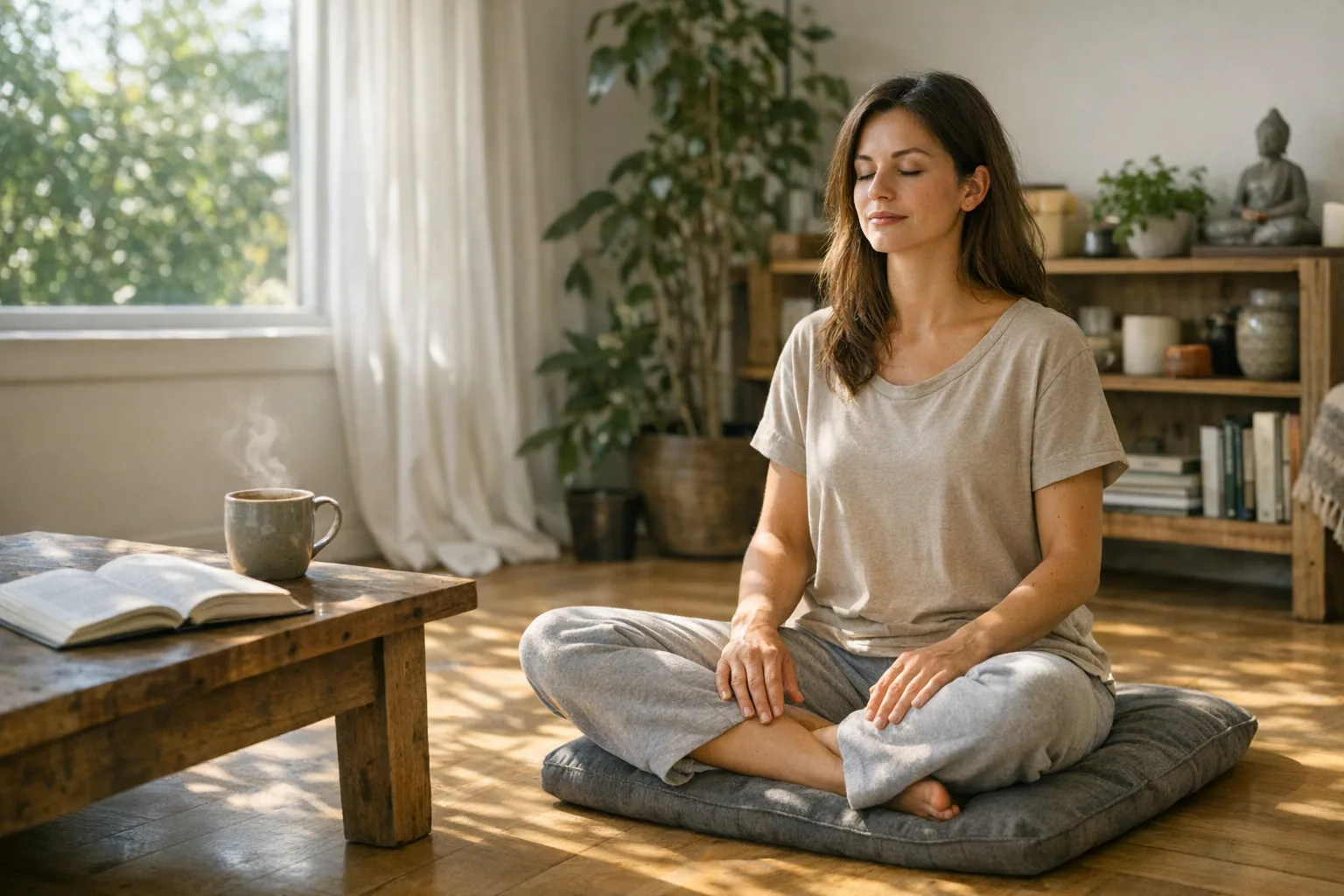
- on a cushion, with hips elevated if that’s comfortable
- on the floor, if your body tolerates it well
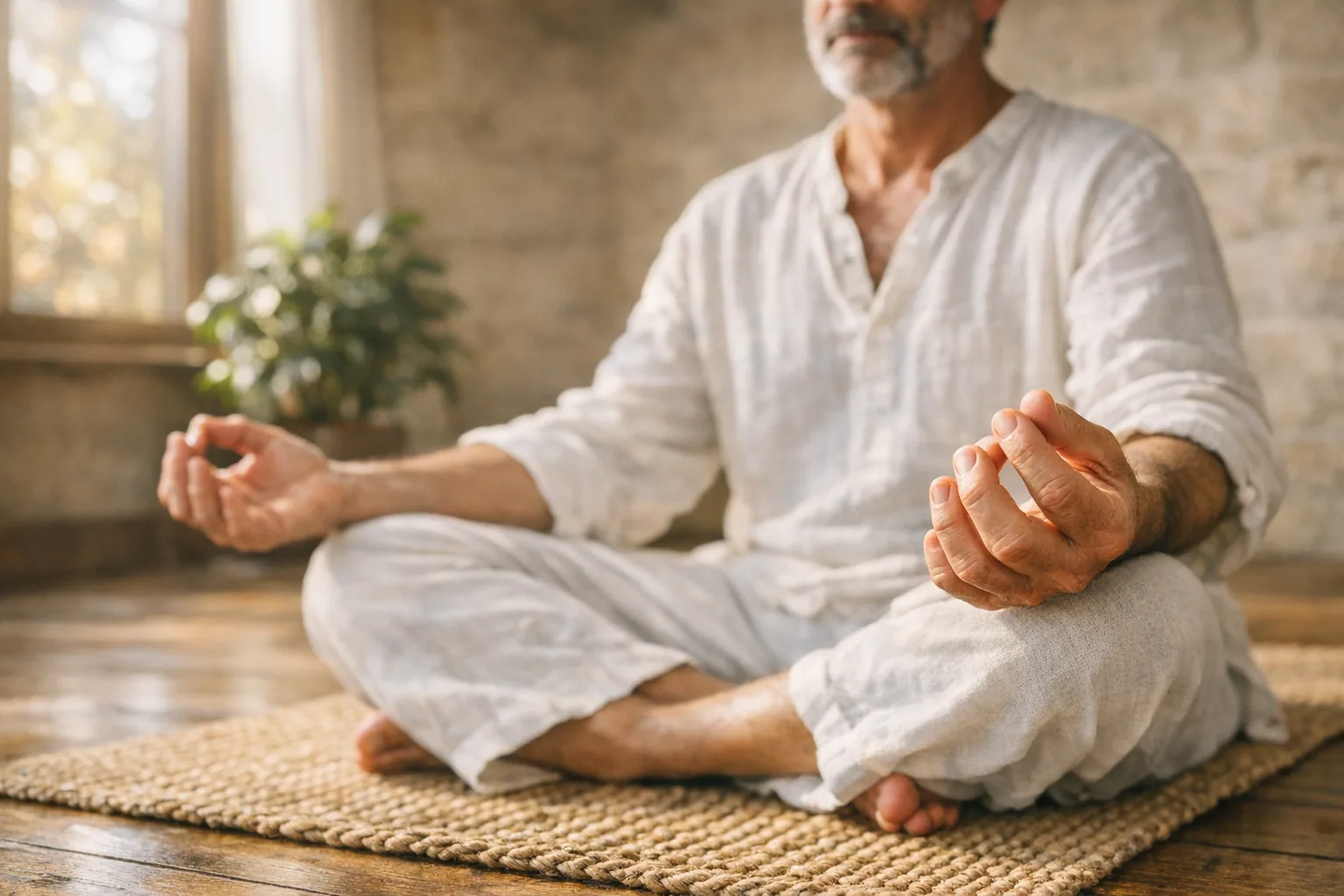
Try to keep your back straight but not rigid. Hands can rest on your legs or lap. Eyes can be closed or half-open.
If something hurts, adjust. Meditation shouldn’t turn into an endurance test.
- Choose a Simple Focus Point
For beginners, the breath usually is the most practical anchor. You don’t need to control it. Just observe it.
You can notice:
- air entering and leaving through the nose
- the movement of the chest or abdomen
- the natural pause between inhalation and exhalation
If the breath doesn’t feel comfortable as your focus, you can use sounds around you or bodily sensations. The important thing is to have a clear reference point.
- When Your Mind Wanders, Come Back
This is the practice.
You will get distracted. You’ll think about tasks, conversations, memories, or plans. That’s okay. It doesn’t mean you’re meditating badly. It means you’re human.
Every time you notice your mind has wandered, recognize it without judgment and return to the chosen focus. That return is the training.
Often progress in meditation isn’t noticeable because it’s not about “having fewer thoughts,” but about reacting with less impulse.
- Close the Session Slowly
When the time ends, don’t get up abruptly. Take a few seconds to notice how you feel.
You can ask yourself:
- What do I feel in my body?
- How is my breathing?
- What is my current mental state?
Don’t look for any specific sensation. Just observe.
A Very Simple Practice for Your First Days
If you want something easy to start today, try this sequence:
- sit comfortably
- set a timer for 5 minutes
- close your eyes or look down
- bring attention to the breath
- whenever you get distracted, come back without anger
- when finished, open your eyes and take a few more breaths
That’s enough to begin.
What to Do with Thoughts During Meditation
One of the most frequent doubts when starting is what to do with a constantly busy mind. The short answer is: nothing special.
You don’t have to fight the thoughts or follow them all. Nor do you have to force yourself to think nothing. You can do something much more useful: recognize there is thought and return to the anchor.
Some people help themselves mentally with a gentle label, such as:
- “thinking”
- “planning”
- “remembering”
- “worrying”
This can help you take distance without getting caught in the content. Then, you return to the breath or the chosen sensation.
Common Mistakes When Starting to Meditate
Thinking that doing it right means not getting distracted
Getting distracted is not failing. It’s part of the process.
Wanting results too quickly
Meditation does not always produce an immediate sense of calm. Sometimes boredom, restlessness, or resistance appear. Those also are part of the practice.
Choosing sessions that are too long
Starting with 20 or 30 minutes when you don’t have a habit yet can make you quit too soon.
Meditating only when you “feel like it”
If you depend solely on motivation, your practice becomes unstable. It’s better to start small and easy to repeat.
Comparing yourself with others
Every experience is different. What you see on social media or hear from someone else is not a useful reference to measure your process.
What Type of Meditation to Choose if You’re a Beginner
There’s no single way to meditate. In fact, it might be easier to start if you choose a specific style instead of trying to “do it all.”
Breath Awareness Meditation
It’s the most accessible option for most beginners. It consists of observing the breath as it is.
Body Scan
You mentally travel through the body, part by part, noticing sensations without trying to change them. It can be helpful if it’s hard for you to stay just with the breath.
Guided Meditation
Ideal if you prefer a voice to accompany you. Today it’s easy to find brief, well-structured sessions. If you choose this path, select serious sources with clear instructions.
Mantra Meditation
A word or phrase is softly repeated. Some people find it helps stabilize attention.
Walking Meditation
If sitting still is very challenging, walking slowly while paying attention to your feet and body sensations can be an excellent way to start.
How Long Does It Take to Notice Benefits
There’s no universal answer. It depends on frequency, technique, life circumstances, and consistency.
Some people notice more clarity or pause within a few weeks. Others take longer. And some discover that rather than a spectacular change, meditation offers them a different relationship with mental noise.
The important thing is not to turn meditation into a test. If you practice several days a week, you’re already building a real foundation.
How to Keep Practicing Without Giving Up
Starting is one thing. Maintaining it is another.
Make It Easy to Repeat
The less complicated the practice, the more likely you are to keep it.
Link It to an Existing Routine
Associating it with a daily habit reduces friction.
Don’t Wait to “Have More Time”
Five minutes done well can fit where twenty won’t.
Keep a Simple Log
No complex diary needed. Just note if you meditated and for how long.
If You Miss a Day, Resume the Next
A break doesn’t erase what came before. Real consistency includes interruptions.
Meditating at Home or in a Retreat: What Can Help More
Starting at home is the most accessible and flexible way. It lets you try, make mistakes, and adjust without pressure. But some people feel more supported when they have a more structured experience, especially if they want to deepen or break from heavy routines.
A meditation retreat can offer:
- more silence and fewer stimuli
- defined schedules
- instructor guidance
- space to disconnect from daily life
- a sustained immersion in practice
It’s not essential to start, but it can be an interesting support when you already have a small base or feel you need a different environment.
If you want to explore this path, you can check various options at meditation and wellness centers or discover location-based options in Retiru’s destinations section.
Meditation Is Not the Same as Relaxation
Sometimes they are used synonymously, but they are not.
Relaxation seeks, directly, a state of rest or deactivation. Meditation can include calm, but its main goal is training attention and observation.
That’s why a meditation session doesn’t always feel “pleasant” at first. Restlessness, sleepiness, boredom, or impatience may appear. And yet, the practice can be valuable.
Signs You Are Starting Well
Although there is no perfect way to measure it, there are reasonable signs you’re on the right track:
- you can sit for a few minutes with some regularity
- you notice more quickly when you get distracted
- you return to practice with less self-criticism
- you begin to observe more than react
- the practice becomes familiar, though not always comfortable
These kinds of changes tend to be more useful than expecting an extraordinary feeling.
When It’s Worth Seeking Guidance
Starting alone is totally possible, but there are situations where external guidance can help a lot:
- if you don’t know which technique to choose
- if you struggle to maintain the practice
- if you want to deepen a particular style
- if you prefer to learn in a group
- if you are looking for a retreat or silent environment
In those cases, reviewing options for retreats in Spain can be a very practical way to advance without going in blind.
A Realistic Approach for Your First Weeks
If you want a simple guideline, you can try this for 14 days:
- days 1 to 4: 3 minutes of breath meditation
- days 5 to 8: 5 minutes
- days 9 to 11: 7 minutes
- days 12 to 14: 10 minutes
Don’t seek perfection. Just observe if you can maintain the habit kindly and without dramatizing low-energy days.
That kind of progression is much more sustainable than starting with ambition and quitting after one week.
Conclusion
Starting to meditate from scratch requires no experience or complex preparation. It requires something simpler and, at the same time, more valuable: the decision to sit a little every day, observe, and come back.
If you start with a short time, a clear technique, and realistic expectations, the practice stops feeling like an abstract challenge and becomes something everyday. And that’s where it really begins.
If you want to keep exploring this path, you can continue reading the Retiru blog, discover meditation and rest proposals at Retiru, or check experiences designed for those who want to learn with support and in nurturing environments.
Ready for your next retreat?
Explore hundreds of retreats across Spain with transparent pricing.
Explore retreats