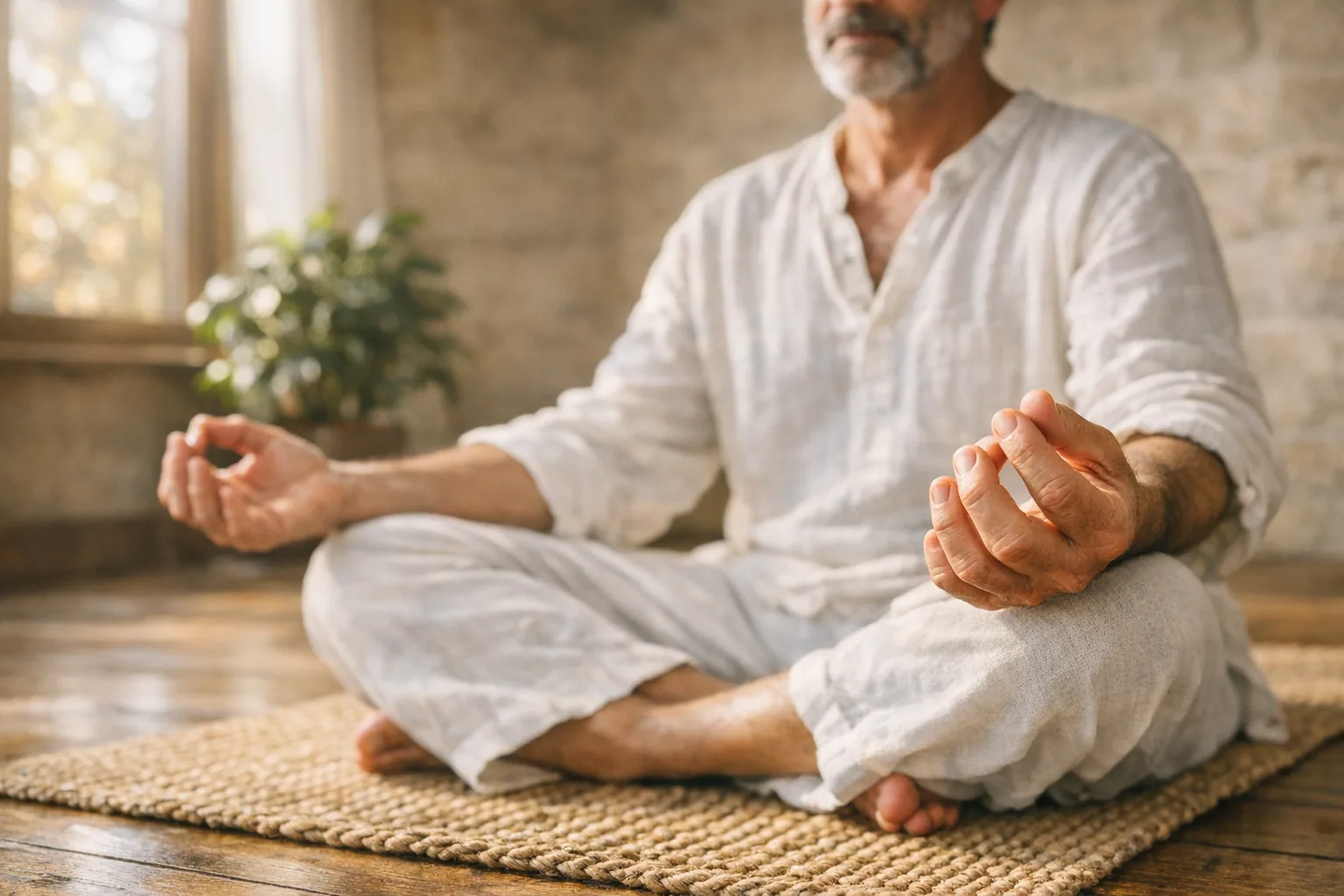
Conscious breathing to reduce stress: practical guide (with exercises you can do today)
Retiru Team
The Retiru content team — yoga, meditation and ayurveda.

Conscious breathing to reduce stress: practical guide (with exercises you can do today)
When stress rises, the body usually goes into “alert mode”: faster, shallower breathing, tension in the jaw and shoulders, racing mind. The good news is that breathing is one of the few automatic functions you can also regulate voluntarily. And that’s its power: conscious breathing doesn’t “erase” your problems, but it can help lower physiological activation and create space to respond more clearly.
In this guide, you’ll find conscious breathing techniques for stress, how to practice them simply, and what mistakes to avoid so they really work for you.
What is conscious breathing (and why it calms)
Conscious breathing means deliberately paying attention to the act of breathing and often gently modifying the rhythm or form (for example, lengthening the exhale). In yoga, this practice relates to prāṇāyāma (control/expansion of the breath), and in mindfulness it is often used as an “anchor” to present-moment attention.
From a physiological standpoint, breathing more slowly with longer exhales can encourage the activity of the parasympathetic nervous system (which helps rest and recover), producing effects that many people notice such as:
- less feeling of urgency or a “knot” in the chest,
- greater emotional stability,
- better ability to focus and make decisions.
A widely studied indicator in this field is heart rate variability (HRV), which relates to autonomic regulation and is often influenced by breathing (especially slow and regular rhythms). It’s not magic: it’s training.
Before you start: 3 keys for it to work (and be safe)
- Less is more. Start with 2–5 minutes. Consistency is more important than a long session.
- Prioritize comfort. If dizziness, strong tingling, or anxiety appear, return to normal breathing and rest.
- Don't force breath holds. Pauses (holding your breath) can be useful, but when stress is high or you’re a beginner, it’s better to keep it gentle.
Responsible note: These practices are for well-being and self-care, not a substitute for medical attention. If you have poorly controlled asthma, COPD, cardiovascular problems, high-risk pregnancy or frequent panic attacks, consult a professional before doing intense techniques or breath holds.
How to tell if you’re breathing with stress (quick signs)
Check right now:
- Are you breathing more from your chest than your abdomen?
- Is your exhale short and “cut off”?
- Do you sigh frequently, yawn tensely, or feel like you have “insufficient” air?
- Do your shoulders rise when you inhale?
It’s not about correcting yourself rigidly, but about becoming aware. That awareness alone starts changing the pattern.
6 conscious breathing exercises to reduce stress (step by step)
- Long exhale (the simplest and most effective to start)
When to use: mild to moderate stress, before a meeting, at the end of the day. Goal: lengthen the exhale to promote calm.
How to do it (2–5 min):
- Inhale through the nose for 3–4 seconds.
- Exhale through the nose for 5–7 seconds (softly, without emptying out completely).
- Repeat, keeping the face and throat relaxed.
Tip: if 7 seconds is too much, try 4–6. The key is to exhale a little longer than you inhale.
- Coherent breathing (steady rhythm, ~5–6 breaths/min)
When to use: to create a stable “floor” of calm; very useful as a daily habit. Goal: slow and consistent rhythm.
How to do it (5 min):
- Inhale 5 seconds.
- Exhale 5 seconds.
- No pauses (at first).
If it’s hard, try 4–4 and gradually increase. Many people find this rhythm helps “organize” body and mind.
- Box breathing
When to use: times of pressure, before public speaking, when you feel scattered. Goal: mental structure + regulation.
How to do it (3–5 min):
- Inhale 4 seconds.
- Hold 4 seconds.
- Exhale 4 seconds.
- Hold 4 seconds.
Repeat 4–6 cycles.
Smart adjustment: if the holds make you uncomfortable, reduce them to 2–3 seconds or skip and keep a steady rhythm.
- Physiological sigh (to quickly reduce activation)
When to use: peak stress, accumulated tension, before sleep if you’re wired. Goal: quickly deactivate.
How to do it (1–3 min):
- Inhale through the nose.
- Without exhaling, take a quick additional mini-inhale (like “filling up” a bit more).
- Exhale long through the mouth, as if releasing weight.
Do 3–5 repetitions then breathe normally. Simple and, when done well, very effective to “slow down the engine.”
- Gentle abdominal breathing (retrain the pattern)
When to use: if you usually breathe high in the chest or feel “short of air” due to tension. Goal: regain amplitude without forcing.
How to do it (5 min):
- Place one hand on your chest and the other on your abdomen.
- Inhale through the nose trying to move the hand on the abdomen more.
- Exhale slowly through the nose or mouth, without pushing.
Important: it’s not about “puffing the belly,” but allowing the diaphragm to work without stiffness.
- Mindful breathing
When to use: when stress comes with mental rumination. Goal: train presence and the relationship with thoughts.
How to do it (5–10 min):
- Sit comfortably.
- Feel the air going in and out (nose, chest, or abdomen).
- When your mind wanders, return without judgment to the sensation of breathing.
Here you’re not trying to “breathe perfectly” but to be with what is.
Quick routines depending on your situation (choose one)
If you have 60 seconds
- 3 “physiological sighs”
- 6 breaths with long exhale (3–6 seconds)
If you have 5 minutes
- Coherent breathing 5–5
- or long exhale 4–6
- or simple mindfulness (counting 10 breaths and repeating)
If you’re about to explode (high stress)
- 1 minute of physiological sighs
- then 2–3 minutes of gentle coherent breathing (4–4 or 5–5)
- finish with 30 seconds observing your body (where did you loosen up?)
Common mistakes that make breathing “not work”
- Forcing too deep. Can cause hyperventilation and dizziness.
- Wanting instant results always. Sometimes calm comes in 1 minute; other times it’s a cumulative practice.
- Doing it only “when you’re terrible.” Works better if you train during neutral moments.
- Rigid posture. If you’re tense, the body doesn’t “receive” the calm signal. Adjust posture, relax your jaw.
When it makes sense to practice on a retreat (and not only at home)
Breathing consciously at home helps, but at a retreat it’s often easier to go deeper because:
- you reduce stimuli (phone, tasks, noise),
- there’s professional guidance (technique and progression),
- it combines with meditation, gentle movement, nature, and rest.
If you want to integrate these practices into a getaway, you can explore yoga and meditation retreats on Retiru and choose by style, level, and location from the wellness retreats section. For inspiration by regions (sea, mountains, countryside), check the destinations guide and the Retiru blog with more practices.
If you’re looking for a steady place to practice continuously, you can check the directory of yoga and meditation centers in Spain.
Conscious breathing and stress: what to realistically expect
With practice, the most common effects are:
- greater ability to “pause” before reacting,
- easier transition into rest (especially at night),
- less sustained body tension,
- clearer mind.
It’s not a unique or linear solution. But it’s a very accessible tool: you always carry it with you.
Conclusion: a small practice that changes the day
Conscious breathing doesn’t ask you to believe in anything: it invites you to try. Start simple—long exhale or coherent breathing—for 5 minutes a day. After a week, you’ll have your own data: how your body, sleep, and patience change.
And if you want to take a step further and practice in an environment that helps disconnection, you can discover options on Retiru: sometimes, changing your air is also changing your breath.
Ready for your next retreat?
Explore hundreds of retreats across Spain with transparent pricing.
Explore retreats